All Jordan Shoes in Order: Timeline from AJ1 to Now
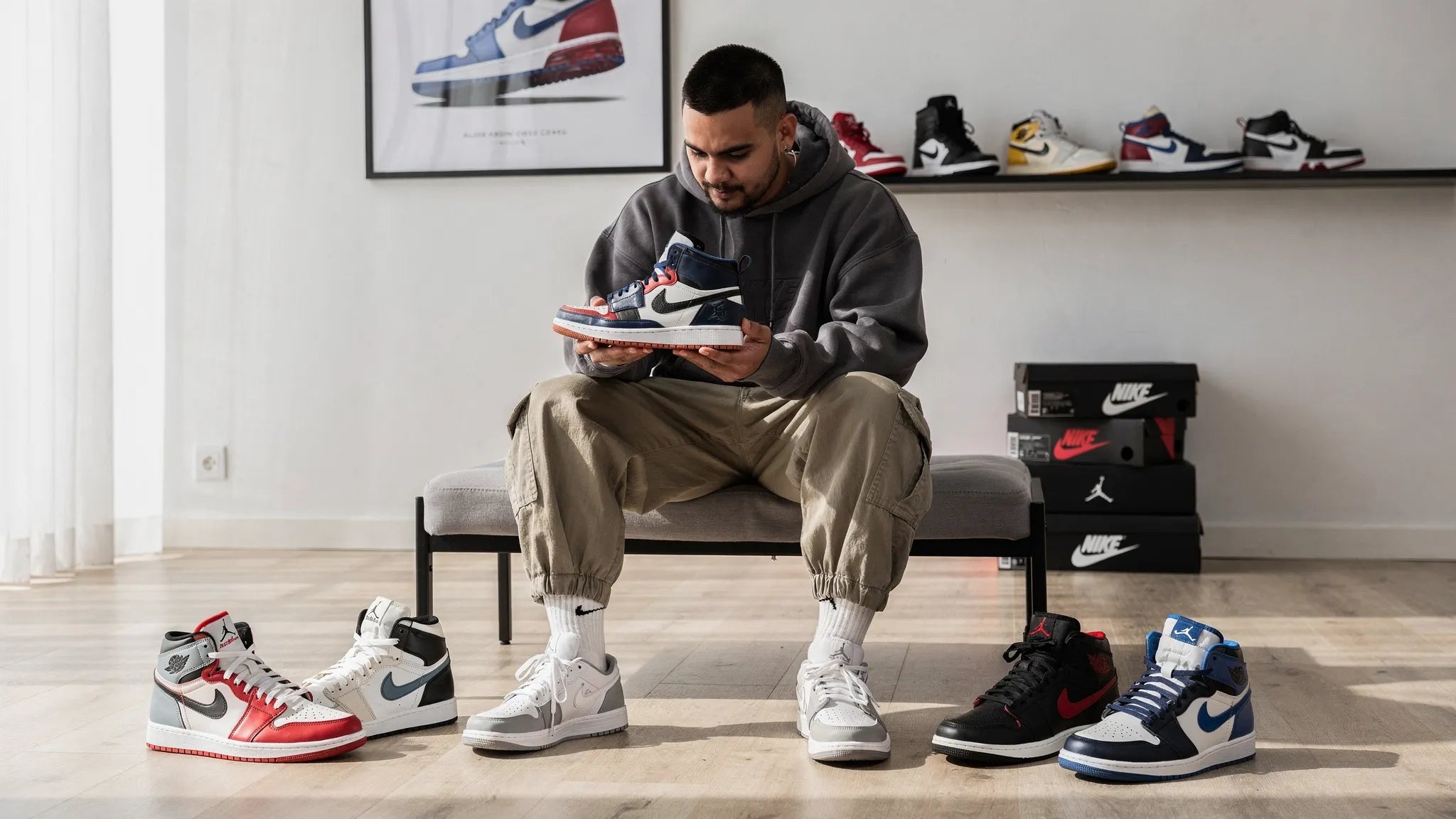
If you’ve ever heard someone say “I’m after the 4s” or “the 11s are the GOAT” and wondered what comes before and after, you’re not alone. The Air Jordan line runs deep, and the naming gets even more confusing once you hit the late-2000s years where Jordan Brand briefly stopped using numbers.
This guide puts all Jordan shoes in order (the main numbered signature line), from AJ1 (1985) through the most recent numbered models, with a clear timeline and the context collectors actually care about.

What counts as an “Air Jordan” in this timeline?
People use “Jordans” to describe a few different things:
- Numbered Air Jordan signature models: AJ1, AJ2, AJ3 … This is the core “Air Jordan” timeline tied to performance innovation and the line’s heritage.
- Retro releases: Re-releases of older models (like AJ4 “White Cement” retros) in new years and colourways.
- Non-numbered Jordan models: Team Jordans, lifestyle silhouettes, and special projects (they’re real Jordans, just not part of the numbered signature sequence).
This article focuses on the numbered signature line because that’s what most people mean when they search for “AJ1 to now”.
The one confusing era: when AJ24 to AJ28 weren’t called AJ24 to AJ28
After Air Jordan XX3 (AJ23), Jordan Brand shifted naming to years:
- Air Jordan 2009 = AJ24
- Air Jordan 2010 = AJ25
- Air Jordan 2011 = AJ26
- Air Jordan 2012 = AJ27
- Air Jordan 2013 = AJ28
Collectors still refer to them as 24 to 28 today, even though the boxes and marketing often used the year names.
All Jordan shoes in order: AJ1 to now (original release years)
The table below lists the main Air Jordan signature models in order, with their commonly accepted original release year and a quick “why it matters” note.
| Air Jordan model | Original release year | What it’s known for (quick context) |
|---|---|---|
| AJ1 | 1985 | The beginning, iconic high-top basketball-to-street silhouette |
| AJ2 | 1986 | Sleeker look, premium build direction for the line |
| AJ3 | 1988 | Elephant print, visible Air, design era shift |
| AJ4 | 1989 | Mesh panels, “wings” lace system, global pop culture moments |
| AJ5 | 1990 | Fighter-jet inspiration, reflective tongue on many versions |
| AJ6 | 1991 | Championship-era classic, sculpted heel tab and panels |
| AJ7 | 1992 | Huarache-style inner bootie feel, bold geometric styling |
| AJ8 | 1993 | Strap-heavy design, associated with a three-peat era |
| AJ9 | 1993 | MJ’s first retirement era, global theme details |
| AJ10 | 1994 | Outsole “achievement list” concept, clean upper blocking |
| AJ11 | 1995 | Patent leather, one of the biggest Jordan cultural icons |
| AJ12 | 1996 | Premium stitched look, strong on-court and off-court legacy |
| AJ13 | 1997 | “Panther” theme, rounded pod outsole look |
| AJ14 | 1998 | Sports car inspiration, late Bulls era signature |
| AJ15 | 1999 | Experimental woven and angled details, bold late-90s design |
| AJ16 | 2001 | Return-era model, often remembered for removable/cover elements |
| AJ17 | 2002 | Luxury-leaning presentation, performance focus of early 2000s |
| AJ18 | 2003 | Last season with the Wizards, refined and technical build |
| AJ19 | 2004 | Off-court friendly vibe, lighter styling compared to earlier retros |
| AJ20 | 2005 | Laser details era, storytelling on the upper |
| AJ21 | 2006 | Low-key look, lifestyle and performance crossover feel |
| AJ22 | 2007 | New cushioning approach for the time, modernising the line |
| AJ23 | 2008 | “23” celebration, premium direction and design callbacks |
| AJ24 (Air Jordan 2009) | 2009 | Year-name start, modern tech push and sustainability talk |
| AJ25 (Air Jordan 2010) | 2010 | Transparent sole concept, visible internal tech storytelling |
| AJ26 (Air Jordan 2011) | 2011 | Interchangeable cushioning concept (different ride options) |
| AJ27 (Air Jordan 2012) | 2012 | System-driven design approach, modular performance mindset |
| AJ28 (Air Jordan 2013) | 2013 | Locked-down fit emphasis, futuristic performance style |
| AJ29 | 2014 | Lightweight performance focus, return to numbered naming |
| AJ30 | 2016 | Modern performance reboot, strong design callbacks |
| AJ31 | 2016 | “Banned” AJ1 colour influence in performance form |
| AJ32 | 2017 | AJ2-inspired design language, modern tech tooling |
| AJ33 | 2018 | Fast, minimal performance direction, elite on-court intent |
| AJ34 | 2019 | Very stripped-back look, built for speed and court feel |
| AJ35 | 2020 | Performance-first build, modern Jordan Brand identity |
| AJ36 | 2021 | Anniversary-era energy, updated performance tooling |
| AJ37 | 2022 | AJ7 visual inspiration, contemporary on-court design |
| AJ38 | 2023 | Court-focused build, continued lightweight performance trend |
| AJ39 | 2024 | Next step in modern performance line, updated design language |
The timeline in “eras” (what changes as you move up the numbers)
If you’re shopping or collecting, the model number alone doesn’t tell the full story. Here’s how the line tends to break down.
AJ1 to AJ6: the foundation years (1985 to 1991)
These are the pairs that built the mythology. Even if you never hoop in them, they’re the silhouettes that anchor Jordan collections.
- AJ1 is the gateway drug for most collectors.
- AJ3 and AJ4 are often where people “level up” because they feel like a different design language than the AJ1.
- AJ6 is deeply tied to early-90s dominance.
If your goal is “one pair that still works with everyday streetwear in 2026,” most people start with AJ1, AJ3, or AJ4.
AJ7 to AJ14: championship run to late-90s peak (1992 to 1998)
This era is about bold shapes and instantly recognisable design moves.
- AJ11 is a resale and retro heavyweight for a reason.
- AJ12 and AJ13 have a premium look that pairs well with modern fits (baggy denim, cargos, oversized tees).
- AJ14 is a classic end-of-era statement.
AJ15 to AJ23: experimentation and transition (1999 to 2008)
These numbers are where the line gets more polarising. Some models are loved for being “different,” others are less common in everyday rotations.
If you like owning pairs that spark conversation (and you’re not chasing the same top five retros everyone posts), the 15 to 23 range is worth exploring.
AJ24 to AJ28: the year-name era (2009 to 2013)
This is where many collectors get tripped up. If you see someone talking about “the Air Jordan 2011” or “the 2012,” it’s still part of the main signature sequence.
These models lean performance and tech, and they’re a reminder that not every Air Jordan is designed primarily as a lifestyle shoe.
AJ29 to AJ39: modern performance line (2014 to 2024)
Modern-numbered Air Jordans are built for the court first, but they still influence how retros are marketed and how Jordan Brand tells stories.
For most collectors in New Zealand, these newer numbers are typically “nice to know” in the history, while the buying focus remains on retro icons (1, 3, 4, 11, 12).
A collector’s shortcut: which Jordans are easiest to wear casually?
If you’re not building a “complete timeline wall,” you probably want pairs that are iconic and actually wearable with your wardrobe.
| If you want… | Common go-to Jordans | Why they work |
|---|---|---|
| A daily streetwear staple | AJ1 | Simple lines, huge colourway variety, easy to style |
| A chunkier retro that still looks premium | AJ3 | Balanced proportions, elevated materials on many releases |
| The “statement” retro | AJ4 | Bold shape, strong collaborations, instant recognition |
| A dressier-feeling classic | AJ11 or AJ12 | Sleeker look, premium vibe, big heritage |
Style is subjective, but these silhouettes consistently show up in long-term collections because they “fit” both the history and modern streetwear.
Buying Jordans in NZ: how the timeline helps you shop smarter
Knowing all Jordan shoes in order is useful, but here’s how it translates into better buying decisions.
1) Separate “retro icons” from “new-number performance”
When a release calendar gets busy, it’s easy to impulse-buy whatever is trending. A quick filter helps:
- If you want heritage and collectability, focus on retro staples (AJ1, AJ3, AJ4, AJ11, AJ12).
- If you want modern on-court performance, look at the newest numbered model and read performance reviews.
2) Learn the “AJ number language” used in listings
In product titles, blog posts, and resale listings you’ll commonly see:
- “AJ1 High,” “AJ1 Low,” “AJ1 Retro High OG”
- “AJ4 Retro”
- “AJ11 Retro”
Those words matter because they often signal different cuts, materials, and release formats. If you’re deep in AJ1s, you’ll enjoy the model-specific breakdown in BigBoiSneakers’ post on Jordan 1 sneakers.
3) Use the era to set expectations on feel and shape
Even when you buy the “same model number,” different production years can feel different. For example, collectors often talk about retro shape tweaks, comfort updates, and materials changing from one run to another.
If you care about details like that, it’s worth comparing:
- Release-year photos and official images
- In-hand reviews from credible sneaker reviewers
- The retailer’s own product photos and return policy
Authenticity matters more than the model number
Jordans are among the most faked sneakers on the planet because demand is global and certain colourways move fast.
If you’re buying online in Aotearoa, use a consistent process. BigBoiSneakers has solid NZ-relevant reading on authenticity, including:
- How to tell if your sneakers are real or fake (Australia & NZ guide)
- Is bigboisneakers.com legit? Everything you need to know
For general background on the line’s history and cultural footprint, you can also cross-check the broader Air Jordan overview on Wikipedia’s Air Jordan page (useful for dates and references, then verify specific releases through official retailer info).
Where to go next (if you’re choosing your next pair)
If this timeline helped you narrow down what you actually like, the fastest next step is browsing by model number and colourway, then verifying the seller and condition.
- To explore what’s available, you can start with a simple on-site search like Jordan sneakers on BigBoiSneakers.
- If you already know you’re a “4s person,” the deeper dive on Air Jordan 4 Retro in NZ pairs well with this timeline.

A quick reminder: “to now” keeps moving
Jordan Brand typically introduces new performance-numbered Air Jordans on an ongoing basis, while retro releases keep the classics in circulation. So think of this guide as your numbered roadmap: once you know where a model sits in the sequence, it gets much easier to understand why it looks the way it does, and why certain pairs are treated like grails.
If you’re shopping in NZ, prioritise authenticity, buy what fits your style (not just hype), and use the model timeline as your filter for what belongs in your rotation.