Sneaker Terms Explained for First-Time Buyers
Buying your first pair of sought-after sneakers can feel like learning a new language. Product names are long, release labels sound mysterious, and small details like “GS” or “VNDS” can completely change what you are buying.
The good news is that most sneaker terms are easy once someone explains them in plain English. This guide breaks down the words you will see when browsing Jordan, Nike, Dunks, Yeezys and other authentic sneakers online, so you can buy with more confidence and avoid common first-time mistakes.
Why sneaker terms matter before you buy
Sneaker terminology is not just slang. It helps you understand size, condition, rarity, price and authenticity. If you know what a product page means by “Retro High OG” or “deadstock”, you are less likely to order the wrong pair or overpay for something you do not actually want.
For first-time buyers in New Zealand, the most important terms usually fall into five groups:
- Sneaker design and product names
- Release type and rarity
- Sizing and fit
- Condition and authenticity
- Buying, shipping and resale language
Once you understand these basics, browsing a sneaker store NZ shoppers trust becomes much simpler.
Essential sneaker terms every beginner should know
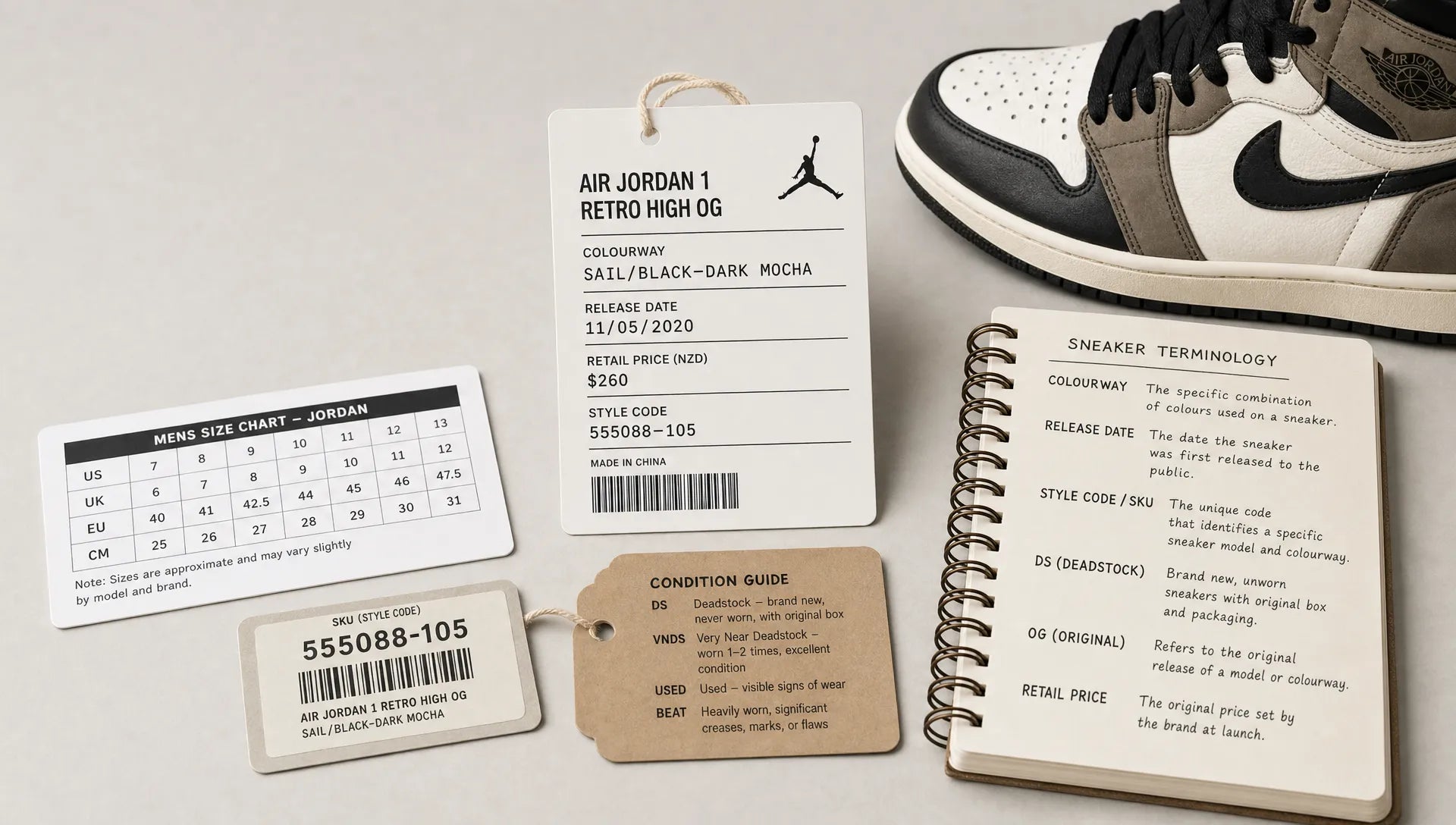
Most sneaker product names are built from a few core parts: the brand, the model, the silhouette, the colourway and sometimes a special release label. For example, “Air Jordan 1 Retro High OG” tells you the sneaker line, the model, the cut and the design inspiration.
| Term | What it means | Why it matters |
|---|---|---|
| Sneaker | Casual or athletic footwear, often collected for style, culture or performance | The general term used across Nike, Jordan, Adidas, New Balance and more |
| Silhouette | The overall shape or model of a shoe | Air Jordan 1, Dunk Low and Yeezy 350 are different silhouettes |
| Model | The specific sneaker family or design | Helps you compare similar pairs across different colours and releases |
| Colourway | The colour combination of a sneaker | Many popular pairs are known mainly by their colourway |
| Upper | The top part of the shoe above the sole | Materials like leather, suede, mesh or canvas affect comfort and care |
| Midsole | The cushioning layer between the upper and outsole | Influences comfort, height and the look of the sneaker |
| Outsole | The bottom of the shoe that touches the ground | Affects grip and wear over time |
| Toe box | The front section around your toes | Important for fit, creasing and comfort |
| SKU or style code | The product identification code used by brands | Useful for checking exact models and colourways |
| Lace swap | Changing the original laces for another colour or style | A common way to personalise sneakers |
A colourway can be official or community-made. Official colourway names come from the brand, while sneaker fans often create nicknames. For example, a shoe may have a formal colour description like “White/Black/University Blue”, but the community might refer to it by a shorter nickname.
Release and hype terms explained
Sneaker culture is closely tied to releases. Some pairs are easy to find, while others sell out quickly because demand is higher than supply. Understanding release terms helps you judge whether a sneaker is likely to be widely available or harder to get.
Drop means a release. When people say “new drop”, they are talking about a new sneaker becoming available for purchase.
Retail is the original selling price set by the brand or authorised retailer. Resale is the price after the sneaker has sold out or moved to the secondary market. Resale can be lower, equal to or much higher than retail depending on demand.
GR, short for general release, usually means the sneaker was produced in larger numbers and is more widely available. GR does not mean bad. Many everyday classics and easy-to-style pairs are general releases.
Limited edition sneakers are produced in smaller quantities or released through selected channels. Limited does not automatically mean better quality, but it can affect availability and price.
Collab, short for collaboration, means a sneaker created with another brand, designer, artist, shop or cultural figure. Collaborations often attract collectors because they usually have a unique story or design. A famous example is the Nike SB Dunk Low Ben & Jerry’s Chunky Dunky, which combines sneaker design with a playful brand partnership.
Grail is a personal dream sneaker. It might be expensive, rare or simply meaningful to the buyer. A grail does not have to be the most hyped shoe in the world. If it is the pair you have wanted for years, it is your grail.
Brick is slang for a sneaker that does not resell for much above retail, or sometimes sells below retail. For first-time buyers, bricks can be great. They often offer better value if you want to wear your sneakers rather than chase hype.
Jordan, Nike and Dunk terms decoded
Nike and Jordan product names can look complicated at first, but many of the same words appear again and again.
OG means original. In Jordan terms, it often refers to details that connect back to the original version of a model, such as branding, shape or heritage colourways.
Retro means a re-release of an older model or design. Jordan Brand frequently brings back classic models as Retro releases, sometimes with small updates in materials, shape or colour.
High, Mid and Low describe the height of the sneaker around the ankle. High-tops rise higher, mids sit around the ankle, and lows are cut below the ankle. A Jordan 1 Retro High OG Light Fusion Red is a useful example of how several terms combine in one product name: Jordan 1 is the model, Retro signals a re-release style, High describes the cut, and OG points to heritage-inspired details.
SB stands for Skateboarding. Nike SB Dunks often include skate-focused features such as extra padding, different materials or special colourways.
AJ simply means Air Jordan. You may see people say AJ1, AJ3 or AJ4 instead of Air Jordan 1, Air Jordan 3 or Air Jordan 4.
SE usually means Special Edition. QS, or Quickstrike, has often been used for more limited or surprise-style Nike releases. SP can refer to Special Project, commonly associated with more premium or concept-driven Nike releases. These labels can vary in meaning depending on the era and model, so treat them as clues rather than guarantees.
Off-White, A Ma Maniére, Travis Scott and similar names often indicate collaborations. For example, the Air Jordan 1 Retro High Off-White University Blue is not just a colourway, it is tied to a major designer collaboration that changed how many people looked at deconstructed sneaker design.
Sizing terms for first-time buyers in NZ
Sizing is one of the easiest places to make a mistake when buying sneakers online. Many sneaker listings use US sizing, even when the buyer is in New Zealand. Do not assume your usual UK, EU or dress shoe size will always match.
| Term | Meaning | What to check before buying |
|---|---|---|
| US M | US men’s sizing | Common for Jordan, Nike and many sneaker releases |
| US W | US women’s sizing | Usually different from men’s sizing, so convert carefully |
| GS | Grade School sizing | Youth sizing, often similar in length to smaller adult sizes but not always identical in fit or materials |
| PS | Preschool sizing | Children’s sizing, smaller than GS |
| TD | Toddler sizing | Toddler shoes, not adult or youth sizes |
| TTS | True to size | Means most buyers choose their normal sneaker size |
| Size up | Choose a larger size than usual | Often recommended for narrow pairs or snug models |
| Size down | Choose a smaller size than usual | Sometimes recommended for roomy silhouettes |
| CM or JP | Foot length measurement in centimetres | One of the most useful ways to compare sizes across brands |
The safest approach is to measure your foot in centimetres and compare it with the size guide for that specific brand or model. If you are between sizes, consider how you will wear the shoe. Thick socks, wide feet and all-day wear may push you toward a half-size up. A snug lifestyle fit may work better true to size.

Condition terms: DS, VNDS, pre-owned and more
Condition language is especially important if you are buying limited edition sneakers, rare finds or pairs from the resale market. A single term can change the value of a pair significantly.
Deadstock, often shortened to DS, usually means the sneaker is brand new and unworn. In many sneaker communities, DS also implies the original box and accessories are included, but always check the listing details.
VNDS means very near deadstock. This usually describes a pair that has been tried on or lightly worn but still looks close to new. Because the term is subjective, photos and seller reputation matter.
Pre-owned means the sneaker has been worn. This is not automatically bad. Some buyers happily choose pre-owned pairs to save money, especially if the condition is clearly shown and the price reflects wear.
OG all means the sneaker includes all original items, such as the box, spare laces, hangtags, paper or special accessories. Not every release comes with extras, so “OG all” depends on what was originally included.
Replacement box means the original shoebox is missing and another box is being used. For collectors, this can reduce value. For people who plan to wear the shoes, it may not matter as much.
No box means exactly that. Again, it can affect collectability and resale value, but it may be acceptable if the price and condition are right.
Factory laced means the shoes still have the original lacing pattern from the factory. Some collectors like this because it can support the idea that the pair has not been worn, although it is not proof on its own.
Authenticity terms and red flags
When you buy sneakers online in NZ, authenticity should be one of your top priorities. Popular Jordan, Nike, Yeezy and Dunk releases are often copied, so it helps to know the language around legit checking.
Authentic sneakers are genuine products made by the original brand. They are not replicas, counterfeits or unauthorised copies.
Reps means replicas. Some people use the term casually, but replicas are not the same as authentic sneakers. If you want genuine products, avoid listings that mention reps, UA or 1:1 copies.
UA, short for unauthorised authentic, is a controversial term often used by sellers to make fake or unauthorised pairs sound more legitimate. For a first-time buyer, it is safest to treat UA as a red flag.
Legit check means reviewing a sneaker to decide whether it is authentic. This can include the shape, materials, stitching, smell, box label, size tag, insole details, outsole pattern and SKU.
Box label is the sticker on the shoebox showing the size, product code and colour description. A mismatched or incorrect label can be a warning sign, although box condition alone does not prove whether a shoe is fake.
B-grade usually refers to a genuine pair with a minor factory flaw. These are different from fakes, but the flaw should be disclosed clearly.
The biggest beginner mistake is judging authenticity from one detail only. A good legit check looks at the whole pair, including the box, labels, materials, construction and seller reliability.
Buying terms you will see on sneaker product pages
Once you understand the shoe itself, the next step is understanding the product page. These terms help you know what you are actually ordering.
In hand means the seller already has the item available. This is different from a pre-order, where the product is expected later.
Pre-order means you are buying before the seller has immediate stock available. Pre-orders can be useful, but you should always understand the expected timing and terms before paying.
Brand new means the product has not been used. For sneakers, check whether this also includes the original box and accessories.
Size run refers to the range of sizes available for a release or in a store. If only one or two sizes are left, the product may be close to selling out.
Restock means more pairs have become available after the initial release or sell-out. Restocks can happen, but they are not guaranteed.
Secure checkout refers to payment processes designed to protect your transaction. When shopping online, look for trusted payment options, clear policies and a professional product page.
Shipping matters for New Zealand buyers because delivery times and costs can vary widely between local and overseas sellers. BigBoiSneakers offers authentic sneakers, streetwear and collectibles with shipping options, so it is worth checking the delivery details on the product you are buying.
Quick cheat sheet before your first sneaker purchase
Before you add your first pair to cart, use this simple checklist to decode the listing:
- Confirm the exact model, silhouette and colourway.
- Check whether the size is US men’s, US women’s, GS, PS or TD.
- Read the condition carefully, especially DS, VNDS, pre-owned, replacement box or no box.
- Look for authenticity language and avoid reps, UA or unclear listings.
- Compare the product code or SKU when available.
- Review shipping, returns, payment options and seller reputation.
- Decide whether you are buying to wear, collect or resell, since each goal changes what matters most.
If you are buying your first pair, comfort and confidence should matter more than hype. A sneaker you love and actually wear is usually a better purchase than a hyped pair that does not suit your style.
Frequently Asked Questions
What does OG mean in sneakers? OG means original. In Jordan and Nike product names, it often points to heritage-inspired details, original-style branding or a connection to an earlier version of the sneaker.
What does GS mean when buying sneakers? GS means Grade School sizing. These are youth sizes, not standard adult men’s sizes. Some GS sizes can fit adults with smaller feet, but the fit, materials and proportions may differ from adult pairs.
What is the difference between retail and resale? Retail is the original price set by the brand or retailer. Resale is the price after the sneaker enters the secondary market, where demand, rarity and condition can raise or lower the price.
Does deadstock always mean brand new? Deadstock usually means brand new and unworn, often with the original box. However, sellers may use the term differently, so always check photos, condition notes and included accessories.
How do I know if sneakers are authentic online? Buy from a trusted sneaker store, review product details carefully and avoid listings that mention reps, UA or unclear authenticity claims. For rare pairs, check the SKU, box label, materials, stitching and overall shape.
Buy your first pair with confidence
Sneaker terms can seem intimidating at first, but they are simply tools for understanding what you are buying. Once you know the basics, words like Retro, OG, GS, colourway, deadstock and collab become helpful signals instead of confusion.
If you are ready to browse authentic sneakers, streetwear and collectibles, explore the latest arrivals at BigBoiSneakers. Start with the terms you now know, check your size carefully and choose a pair that fits your style, not just the hype.