GX and EX Pokémon cards for sale: key differences explained
If you’ve been searching “GX and EX Pokémon cards for sale”, you’ve probably noticed two things fast: listings often mix the terms, and prices can be all over the place.
That confusion is normal because “EX” and “GX” refer to different eras and mechanics in the Pokémon Trading Card Game, and “EX” in particular can mean two separate types depending on the year.
This guide breaks it down in plain English so you can buy the right card, spot what you’re actually looking at in photos, and understand why one EX or GX can be $10 while another is $1,000+.
What are EX Pokémon cards?
“EX” is used in Pokémon TCG in two major eras, and they are easy to mix up if you only see “EX” in a listing title.
1) Pokémon-ex (lowercase “ex”, 2003 to 2007)
These are from the EX Series (sets like EX Ruby & Sapphire through EX Power Keepers). The card name typically looks like “Blaziken ex” (lowercase “ex”).
Key traits collectors care about:
- Older printing era, often scarcer in high grade.
- Distinct card layout compared to modern ultra rares.
- Strong nostalgia for early 2000s collectors.
2) Pokémon-EX (uppercase “EX”, 2011 to 2016)
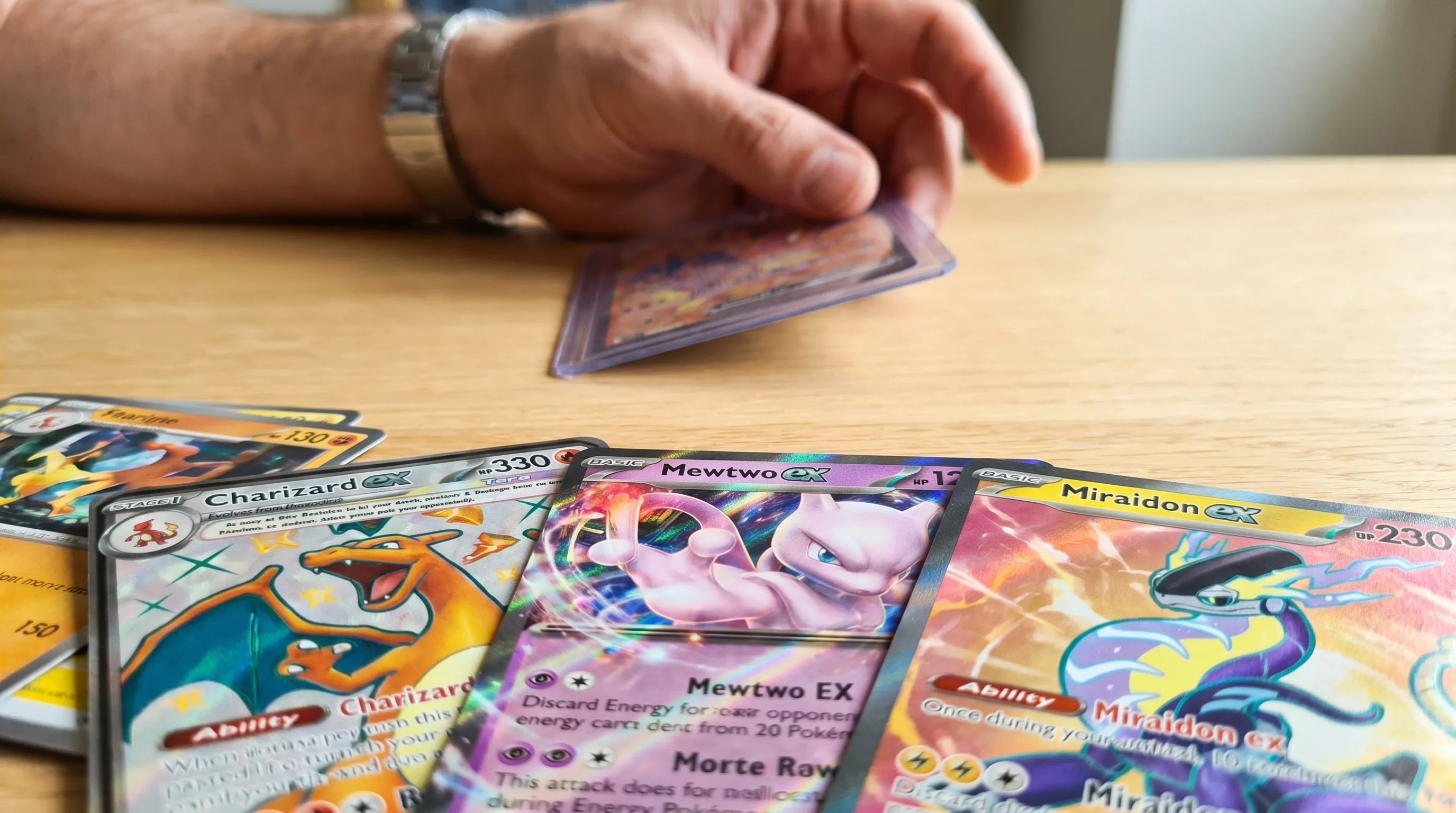
These appear mainly in the Black & White and XY eras. The name looks like “Mewtwo EX” (uppercase “EX”).
Key traits:
- Usually high HP, strong attacks, and a modern “Rule Box”.
- In most formats at the time, the opponent took two Prize cards when a Pokémon-EX was Knocked Out.
- Many have popular variants like Full Art and Secret Rare prints.
If a seller says “EX card” but doesn’t state the set or show the close-up name line, ask which type it is. A 2004 “ex” and a 2014 “EX” are not the same category.
What are GX Pokémon cards?
Pokémon-GX cards are from the Sun & Moon era (roughly 2017 to 2019). The name looks like “Charizard GX”.
What made GX unique:
- When a Pokémon-GX was Knocked Out, the opponent typically took two Prize cards.
- GX cards introduced GX attacks, special attacks you could generally use only once per game (you’ll see “(You can’t use more than 1 GX attack in a game.)” style text on the card).
- The era produced a lot of visually iconic chase cards, including textured Full Arts and “Rainbow Rare” style finishes.
For rules history and terminology, Pokémon’s official site and references like Bulbapedia are helpful when you want to verify a card type from an unfamiliar set.
GX vs EX: key differences at a glance
Here’s the simplest way to compare what you’re buying.
| Feature | Pokémon-EX (2011 to 2016) | Pokémon-GX (2017 to 2019) | Pokémon-ex (2003 to 2007) |
|---|---|---|---|
| Era | Black & White, XY | Sun & Moon | EX Series (early 2000s) |
| Name styling | “EX” uppercase | “GX” uppercase | “ex” lowercase |
| Prize cards given up (typical) | 2 | 2 | Often 2 (era-specific rules) |
| Signature mechanic | Big basics, strong rule box cards | GX attack (usually once per game) | Early-era “ex” power cards |
| Common collector appeal | Character popularity, Full Arts, nostalgia for XY | Big chase cards, modern textures, iconic art | Older scarcity, vintage-era grading demand |
How to tell if a listing is EX or GX (even from one photo)
When you’re browsing marketplace photos or quick product thumbnails, use these fast checks.
Check the name line first
This is the quickest and most reliable signal:
- “Charizard GX”: Sun & Moon era GX.
- “Charizard EX”: BW/XY era Pokémon-EX.
- “Charizard ex”: older EX Series Pokémon-ex.
If the name line is cropped out, treat the listing as incomplete and request a clearer image.
Look for GX attack text
GX cards usually have a dedicated GX attack with the GX rule restriction in the text box. If you see that “once per game” style GX restriction, you are looking at GX, not EX.
Identify the era via set symbol and numbering
Most English cards show a set symbol and collector number near the bottom.
Practical buying tip: open a set database and confirm the exact print.
- For set checklists and card numbers, Pokellector is a common reference.
- For card-by-card variants, Bulbapedia often documents alternate prints.
Full Art texture cues (use carefully)
Many GX and EX Full Arts have texture, but texture alone is not proof of authenticity. Use it as one clue, not the only one.
If you are buying higher-value cards, ask for:
- A bright angled photo showing surface texture (if applicable).
- A close-up of corners and edges.
- A photo of the back (centering and print quality issues show up fast there).

Which is worth more: GX or EX?
There’s no universal winner. Value depends more on the specific card than the mechanic label.
That said, there are predictable price drivers that show up again and again.
1) Character demand and artwork
Popular Pokémon (Charizard, Umbreon, Rayquaza, Mewtwo, Gengar) tend to command higher prices across all eras. Unique artwork, iconic poses, and sought-after artists can also create a premium.
2) Set context and pull difficulty
Some sets are opened heavily, others weren’t. Cards from products that were printed less, or that became popular years later, often end up scarcer in the market.
3) Condition (and why “Near Mint” needs proof)
For singles, condition is often the biggest swing factor.
- Whitening on the back edges can move a card down a condition tier.
- Surface scratches show up under direct light.
- Dents and creases typically crush value, even if the front looks clean.
If you’re buying online, it’s reasonable to request photos that prove condition rather than relying on a single “NM” label.
4) Graded vs raw
Grading can increase liquidity for high-demand cards, but it also introduces a premium that only makes sense if the card is truly clean.
If you’re new to buying graded cards, this site guide may help you avoid common mistakes: Best place to buy Pokémon singles online in NZ: safe checklist.
Should you buy GX/EX as singles, sealed, or graded?
Because this search is usually purchase-driven, here’s a practical way to decide.
Buy singles if you want a specific card
Singles are best when:
- You want one chase card (no gambling on packs).
- You care about condition and want to choose the exact copy.
- You’re completing a binder page or a character collection.
If you are still building your fundamentals as a buyer, BigBoiSneakers has a NZ-focused starting point here: Pokémon card store NZ: English cards & TCG online.
Buy sealed if you want the opening experience or long-term display
Sealed product is best when:
- You enjoy ripping packs and accept variance.
- You want a giftable product.
- You’re collecting sealed items for display.
Just keep expectations realistic. Official pull rates are often not published, and claims online can be exaggerated. BigBoiSneakers covers that mindset in their set guides (example: Pokémon Ascended Heroes: release, pull rates and top chase cards).
Buy graded if the card is high value and condition-sensitive
Graded can make sense when:
- You are buying a high-end card where authenticity and condition are everything.
- You want an easier-to-resell format.
But do not overpay for a low grade just because it’s in a slab. Learn what drives price first.
Buying GX and EX Pokémon cards for sale: a simple safety checklist
Counterfeits and misleading listings are common in modern collectibles. When you’re shopping GX and EX singles, use this workflow.
Verify the exact card
Before paying, confirm:
- Exact name variant (EX vs GX vs ex)
- Set name and collector number
- Rarity and whether it’s a Full Art, Secret Rare, promo, or standard print
Vet the seller, not just the photos
A trustworthy seller usually has:
- Clear business identity and contact options
- Real photos of the exact card
- Transparent condition notes and return policy
- Secure payment options
If you want a deeper NZ-specific framework, use: Best Pokémon website store: how to spot legit sellers and Reputable Pokémon card sellers: green flags and red flags.
Watch for EX/GX listing red flags
Be extra cautious if:
- The title says “EX” but the photo shows “GX” (or vice versa).
- The seller refuses to show the back of the card.
- Price is dramatically below market for a known chase card.
- The listing uses only stock images for a high-value single.
Quick recommendations: what to buy based on your goal
If you’re a collector
Pick what you love first, then optimise.
- Choose a favourite Pokémon and collect EX or GX across multiple sets.
- Focus on condition and consistent binder quality.
- Consider older “ex” cards if you like vintage-era scarcity.
If you’re a player
Check legality and format rules first (they change). For many buyers, older EX and GX are more about collecting than current competitive play.
If you’re gifting
GX cards are often an easy win because the era has bold designs and lots of recognisable Pokémon. Just make sure the gift matches the recipient’s tastes (some prefer vintage “ex”, others chase modern textured cards).
Frequently Asked Questions
Are Pokémon-EX and Pokémon-ex the same thing? No. Pokémon-ex (lowercase) usually refers to the 2003 to 2007 EX Series era, while Pokémon-EX (uppercase) is mainly 2011 to 2016 (BW/XY era).
How can I tell if a card is GX from a listing photo? Look for “GX” in the name line and a GX attack with the once-per-game style restriction text. If the name line is cropped, ask for a clearer photo.
Do GX cards always have a GX attack? Most Pokémon-GX feature a GX attack, and the card text typically states you can’t use more than one GX attack per game.
Are GX cards more valuable than EX cards? Sometimes, but not always. Value depends on the specific Pokémon, set, rarity variant (Full Art, Secret Rare, promo), and condition.
What’s the safest way to buy GX and EX Pokémon cards online in NZ? Buy from reputable retailers or well-reviewed sellers who provide clear photos, condition details, secure payment, and transparent shipping and return policies.
Shop authentic GX and EX Pokémon cards with confidence
If you’re ready to browse GX and EX Pokémon cards for sale without the guesswork, start with a retailer that prioritises authenticity, clear product info, and secure checkout.
Explore BigBoiSneakers for authentic Pokémon TCG products, including singles and sealed options: BigBoiSneakers Pokémon cards. You can also use their buyer resources to shop smarter, especially if you’re comparing sellers or evaluating condition before you commit.