
Jordan 11 Sizing Guide for NZ Buyers
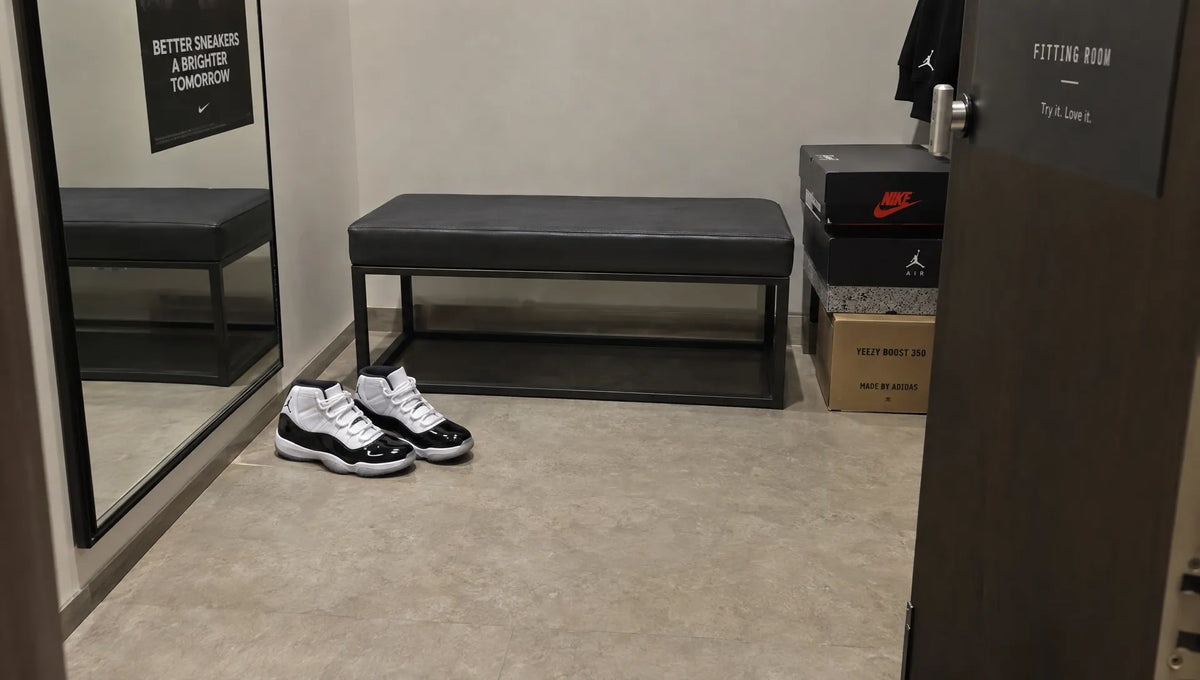
Jordan 11 sizing usually starts with your normal Nike or Jordan size, but foot width matters almost as much as length. The firm patent-leather section around the lower upper can make a correctly sized pair feel snug, particularly across a wider forefoot. Going up a size automatically, however, can leave your heel moving inside the shoe.
For NZ buyers, the other common trap is confusing US, UK and women’s sizing. This guide explains which size to start with, how to read the labels and what to check before committing to a pair online.
Do Jordan 11s run big or small?
Most people with average-width feet should start true to size in the standard Air Jordan 11 Retro. Expect a close, secure fit rather than a roomy toe box. True to size means your usual size in a well-fitting, comparable sneaker, not necessarily your size in every shoe brand.
If you have wide feet or regularly feel pressure over the top of your foot, trying half a size up is sensible. It is not a universal fix: extra length can create heel movement without giving you enough width where you need it.
| Your usual fit experience | Sensible starting point |
|---|---|
| Average-width feet, comfortable in your usual Nike size | Try that same size first |
| Wide forefoot or recurring pressure across the instep | Compare your usual size with half a size up |
| Narrow feet | Start with your usual size and check heel hold |
| Between sizes in comparable sneakers | Compare both sizes using your intended socks |
Do not size down simply to make the shoe look neater. A shorter shoe cannot compensate for a mismatch in width or heel shape.
Measure your feet before choosing a size
For reliable Jordan 11 sizing, start with measurements rather than the number on an old, stretched-out pair.
Measure both feet later in the day, wearing the type of socks you plan to use. Stand on a sheet of paper with your heel lightly against a wall, place your weight evenly and have someone mark the end of your longest toe. Measure the straight distance from the wall to that mark in centimetres.
Repeat on the other foot and use the longer measurement. If you are measuring alone, take care not to curl your toes or shift your heel while reaching forward.
Compare that result with the foot-length measurement on Nike’s official men’s footwear size chart. If the chart gives a recommendation for your measured foot length, do not add an extra centimetre yourself. The sizing recommendation already accounts for fitting space.
Keep a note of the size and model of a sneaker that fits you well, too. “US men’s 10 in a Jordan 1, with a little spare toe room” is a more useful reference than “usually a 10”.
US, UK, EU and CM size conversions
The following table shows standard Nike adult men’s size-label conversions. It translates the labels you may see on a listing or box; it does not replace checking the fit of the particular release.
| US men’s | UK | EU | CM/JP size label |
|---|---|---|---|
| 7 | 6 | 40 | 25 |
| 7.5 | 6.5 | 40.5 | 25.5 |
| 8 | 7 | 41 | 26 |
| 8.5 | 7.5 | 42 | 26.5 |
| 9 | 8 | 42.5 | 27 |
| 9.5 | 8.5 | 43 | 27.5 |
| 10 | 9 | 44 | 28 |
| 10.5 | 9.5 | 44.5 | 28.5 |
| 11 | 10 | 45 | 29 |
| 11.5 | 10.5 | 45.5 | 29.5 |
| 12 | 11 | 46 | 30 |
| 13 | 12 | 47.5 | 31 |
The CM/JP size label is not the same thing as your measured foot length. For example, a US men’s 10 carries a 28 CM label, but that does not mean everyone with a 28 cm foot should choose it. Use Nike’s foot-length row when converting an actual measurement.
There is no separate, universal NZ sneaker size. Local listings can use different systems, so confirm whether an unqualified “size 10” means US men’s, US women’s or UK before ordering.
How width and the patent-leather upper affect fit
The key Jordan 11 sizing question for wider feet is whether the snugness comes from the shoe’s length or its shape.
If your longest toe reaches the front, you need more length. If you have adequate space in front but pressure against the sides of your forefoot, width is the more likely problem. Pressure over the top of the foot can also reflect a higher instep or overly tight lacing.
The patent-leather section may soften with wear, while the lining and padding can settle. Neither change should be relied on to rescue a painful fit. A shoe that causes numbness, pinching or curled toes is not simply waiting to break in.
Try easing the lower laces before changing sizes. If the pressure remains, compare half a size up and check whether your heel still stays secure. If it becomes too long while remaining tight across the forefoot, the model may not suit your foot shape.
For narrow feet, start at your normal size. Use the lacing to secure the midfoot rather than immediately choosing a shorter pair.
Compare with sneakers you already own
An existing pair is useful only if you know how that model fits you.
If your Jordan 1 fits comfortably at your normal size, the same labelled size is a reasonable starting point for an 11. The feel will not be identical: the upper construction and pressure points differ. Our Jordan 1 Low sizing guide can help you establish that reference if you are comparing the two.
Air Force 1 owners need more care. If you deliberately wear an AF1 half a size below your usual Nike size, do not automatically transfer that reduced size to an 11. The Air Force 1 fit guide explains why that model can call for a different choice.
A useful Jordan 11 sizing comparison includes three details: the other model, its labelled size and whether it feels roomy, close-fitting or tight. Brand name alone is not enough.

Retro, Low, women’s and GS pairs: check the exact version
Standard Retro and Retro Low
Your usual size is a reasonable starting point for both the standard Jordan 11 Retro and Retro Low. The lower collar changes how the ankle area feels, so do not assume an equally secure fit just because the size number matches.
Release year, materials and wear condition can also affect the experience. Trying a well-worn older pair is not a perfect test for a new release, and a colourway name alone is not a reliable reason to size up or down.
Women’s and Grade School sizing
Nike’s standard US adult conversion generally puts women’s sizes 1.5 numbers above men’s. A US men’s 8 therefore corresponds to a US women’s 9.5. Check the specific listing and box label rather than assuming every retailer displays the same size category.
Grade School pairs, often marked GS or Y, use youth sizing. A 7Y is not a US women’s 7. Even where a youth size overlaps numerically with an adult men’s size, construction and fit can differ, so confirm the chart for that version.
Low IE and CMFT models
Jordan 11 Low IE and Jordan 11 CMFT models are not simply the standard Retro with a different name. Their construction differs, so use guidance for the exact model rather than assuming a standard Retro fit recommendation will transfer unchanged.
What a good fit should feel like
When checking Jordan 11 sizing at home, wear your normal socks and try both shoes. Lace them securely without pulling so hard that the upper presses into the top of your foot.
A small amount of space ahead of your longest toe, roughly 1 cm as a starting point, is useful. Toe-box height and width matter as well: your toes should rest naturally rather than curl, overlap or press against the upper.
Walk around on a clean indoor surface, turn and gently bend your knees. Check for:
- Toe clearance: Your longest toe should not repeatedly hit the front as you step.
- Forefoot comfort: A close fit is fine, but sharp side pressure or tingling is not.
- Heel hold: Your heel should feel secure without pronounced slipping or rubbing.
- Instep comfort: The laces should hold the shoe without creating painful pressure across the top of your foot.
For basketball use, test fit with your playing socks and any insoles or orthotics you intend to wear. A relaxed casual fit may not provide the containment you want during changes of direction.
Keep the pair unworn outdoors until you have decided, and follow the seller’s return conditions rather than assuming a size exchange will be available.
Frequently asked questions
Should I go half a size up in Jordan 11s? Start true to size if your feet are average width. Half a size up is worth comparing for wider feet, a high instep or a between-sizes fit, provided it does not introduce excessive length or heel slip.
Will Jordan 11s stretch after wearing them? Some softening and settling can occur, but do not expect a meaningful increase in length or enough stretching to fix painful forefoot pressure. They should be comfortable before you commit to wearing them outside.
Is Jordan 11 sizing the same for every release? Not necessarily. Use your usual size as a starting point, then account for the exact version, materials and size category. Retro, Low IE, CMFT and GS pairs should not be treated as interchangeable.
Can I buy the next size up if my size is sold out? Only if that size genuinely fits. A rare colourway is not a good reason to accept persistent heel movement or extra length. Check another release or wait for a suitable pair instead.
Choose the fit before the colourway
Before buying, confirm the full model name, size category and whether the listing uses US or UK sizing. Keep your foot measurements and best-fitting sneaker reference handy, then check the seller’s exchange or return terms.
When you are ready to browse sneakers at BigBoiSneakers, use those details to assess the specific pair. If the sizing label is unclear, ask before checkout rather than guessing from the number alone.