How to Buy Authentic Pokémon Cards Without Getting Burned
Pokémon cards are fun to collect, rip, trade and display, but the market rewards buyers who slow down before they pay. Counterfeit singles, resealed packs, vague listings and fake “too good to miss” deals are all common enough that every collector needs a basic safety routine.
If you want to buy authentic Pokémon cards without getting burned, the goal is not to become a professional authenticator overnight. The goal is to stack the odds in your favour: know exactly what you are buying, choose sellers with a track record, compare real prices, use safe payment methods and inspect the item as soon as it arrives.
This guide is written for New Zealand collectors, but the same checks apply whether you are buying locally, from Australia, or from an overseas marketplace.
What “authentic” should mean before you buy
An authentic Pokémon card is an official Pokémon TCG product released by The Pokémon Company, not a proxy, replica, custom card, fake slab, altered card or resealed product being passed off as factory sealed.
That sounds simple, but many bad purchases happen because the buyer and seller are not talking about the same thing. A card can be real but damaged. A product can be sealed but not factory sealed. A card can be a legitimate reprint but advertised like an older version. A graded slab can contain a real card but still be listed with misleading condition claims.
Before you pay, identify the exact product type:
- Raw single card
- Graded card
- Booster box
- Elite Trainer Box
- Booster bundle
- Collection box
- Loose booster packs
- Mystery pack or repack
- Trading card lot
Each category has different risks, so your checks should change depending on what you are buying.
Start with the exact card, set and variant
The fastest way to overpay or buy the wrong item is to search for a character name only. “Charizard,” “Pikachu” or “Mewtwo” is not enough. Most popular Pokémon have dozens, sometimes hundreds, of cards across different sets, languages, rarities and printings.
Use the official Pokémon TCG card database or another trusted checklist to confirm the card’s full identity before comparing prices. For singles, you want to know the card name, set name, card number, language, rarity, foil type and whether it is a special variant.
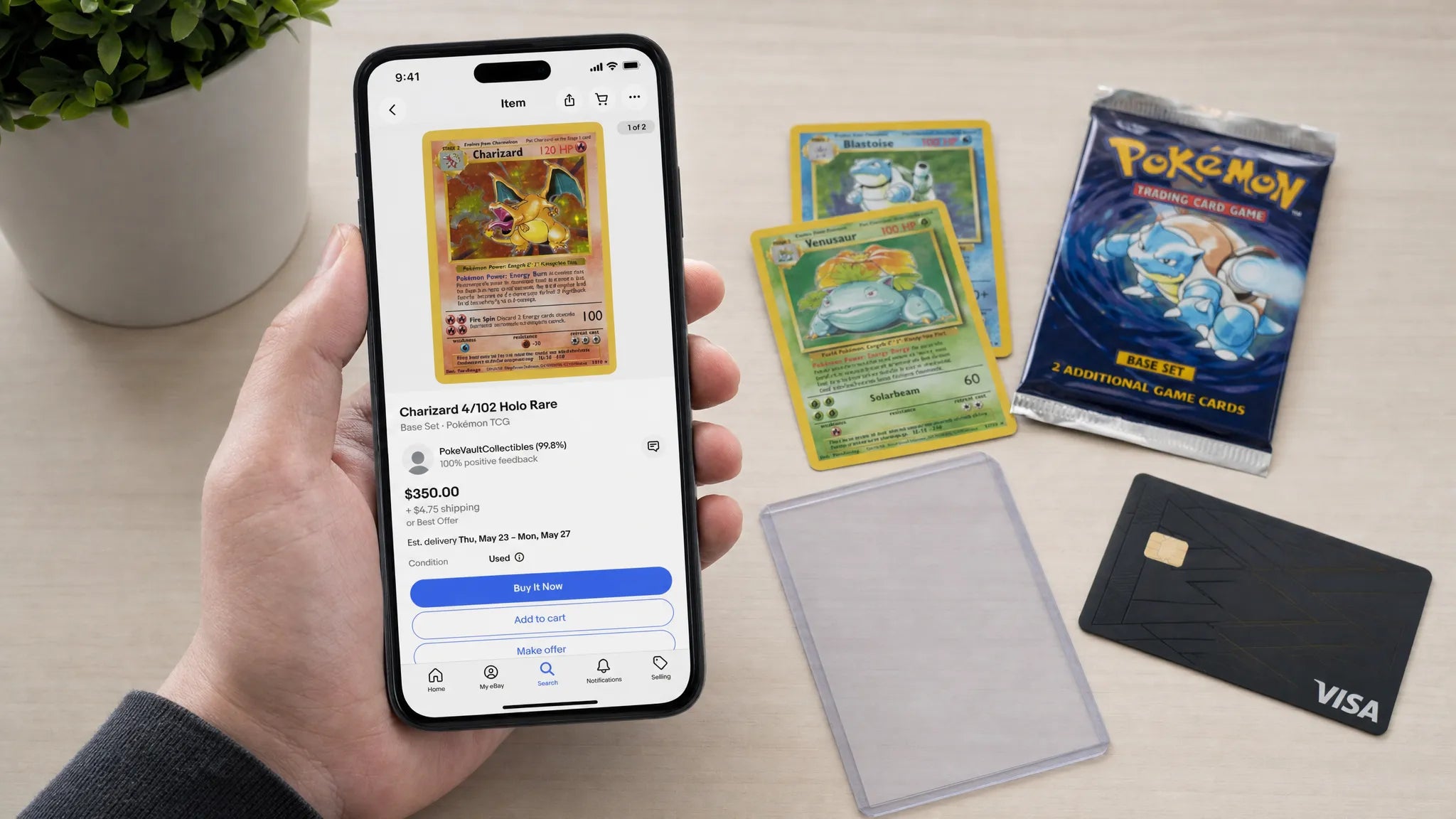
For example, a listing for “rare Charizard holo” should immediately make you pause unless the seller clearly shows the set symbol, card number and condition. A good listing makes the exact version obvious.
| Detail to confirm | Why it matters |
|---|---|
| Set name and card number | Separates similar cards with very different values |
| Language | English, Japanese and other language cards can price differently |
| Rarity and finish | Holo, reverse holo, full art, secret rare and textured cards are not interchangeable |
| Condition | Small surface marks, whitening or dents can change value heavily |
| Grading company and cert number | Needed to verify graded cards before buying |
If you are still learning card versions, start with our guide to Pokémon card prices, condition, rarity and demand before chasing expensive singles.
Choose the buying route that matches your risk tolerance
There is no single “best” place to buy Pokémon cards. A reputable local retailer is usually lower risk, while peer to peer marketplaces may offer more unusual items but require more work from you.
The table below shows the usual risk profile by product type.
| Product type | Main risk | Safer buying move |
|---|---|---|
| Sealed products from retailers | Overpaying or buying the wrong format | Buy from established stores with clear product pages |
| Raw singles | Counterfeits and hidden condition issues | Require clear front, back and close-up photos |
| Graded cards | Fake slabs or wrong certification details | Verify the cert on the grader’s own website |
| Loose booster packs | Weighed, searched or repacked packs | Prefer sealed boxes, blisters or trusted retailer stock |
| Mystery packs | Poor value and unclear contents | Treat as entertainment, not guaranteed value |
| Bulk lots | Low-value cards advertised as “rare” | Ask for sample photos and a clear breakdown |
If you are buying from a store, look for clear product descriptions, secure checkout, realistic pricing and transparent shipping information. If you are buying from a private seller, you need stronger evidence because consumer protections can be more limited.
For a deeper seller-focused checklist, read our guide to reputable Pokémon card sellers.

How to check raw Pokémon cards before buying
Raw singles are where many buyers get caught. A raw card is not graded, so you are relying on photos, seller honesty and your own inspection.
Start by comparing the card to confirmed images of the exact same version. Look at the set symbol, card number, borders, text placement, energy symbols, attack text, copyright line and holo pattern. Counterfeits often fail on small details, not just obvious ones.
Next, check whether the finish matches the card. Some modern full art, alternate art and secret rare cards should have texture. If a card that should be textured appears completely flat, that is a red flag. However, do not assume every valuable card must be textured. Different eras use different finishes.
Also inspect the condition carefully. Whitening on the back edges, dents, binder marks, scratches and surface clouding can all reduce value. Ask for angled light photos for foil cards, because surface issues are often invisible in flat photos.
Avoid destructive “tests” such as ripping a card to inspect the inner layer. That damages the card and still does not give a complete authentication answer. Use comparison, seller evidence and professional grading for high-value purchases instead.
How to avoid resealed or tampered sealed product
Sealed products feel safer than singles, but they still need checks. A booster box, ETB or collection box can be genuine product that has been tampered with and resealed. Loose packs carry more risk because you often cannot confirm where they came from.
For sealed Pokémon products, compare the packaging to known examples of the exact product. Do not rely on one universal rule because packaging changes by era, product type and region. A factory-sealed booster box, an Elite Trainer Box and a blister pack all have different sealing styles.
Watch for these warning signs:
- Loose or messy shrink wrap where the product should be tight
- Heat marks, cloudy glue or inconsistent seams
- Packs facing unusual directions inside display boxes
- Box corners that look opened, crushed and repressed
- Missing product codes, incorrect artwork or low-quality printing
- Sellers who cannot explain where the stock came from
Price is another clue. A sealed product priced far below normal market value is not automatically fake, but it needs an explanation. Clearance, damaged boxes and local promotions can be legitimate. “I have unlimited stock of a sold-out product at half price” is not a good sign.
If you are buying sealed boxes online, our guide on how to buy Pokémon booster boxes without regret covers cost-per-pack checks and sealed inspection in more detail.
Graded cards: verify the slab, not just the label
Graded cards can reduce some uncertainty because a third-party grading company has assessed the card. That does not mean you should skip checks. Fake slabs, copied certification numbers and misleading photos are real risks.
Before buying, ask for clear photos of the front and back of the slab. The certification number should be visible. Then verify it directly through the grading company’s own database, such as PSA Cert Verification for PSA cards. For CGC, Beckett or other graders, use that company’s official lookup tool.
When checking a graded card, confirm that the cert result matches the listing. The card name, set, grade, certification number and label details should all line up. If the cert belongs to the right card but the photos look different, ask questions before paying.
Also remember that the grading company matters. A PSA 10, BGS 10, CGC 10 and an unknown “gem mint” slab are not treated the same by the market. If resale value matters, compare sold prices for that exact grader and grade, not just the card itself.
Price sanity checks: the best defence against bad buys
Most scams rely on urgency. The seller wants you excited enough to pay before checking the price properly. Slow down and use sold prices, not asking prices.
An asking price is what someone hopes to get. A sold price is evidence of what buyers have recently paid. Search recent sold results on marketplaces and price-tracking tools such as PriceCharting, then adjust for condition, language, grading company and shipping to New Zealand.
For NZ buyers, calculate the real cost before deciding whether a deal is good:
| Cost item | Why to include it |
|---|---|
| Card or product price | The headline price can be misleading by itself |
| Shipping | Overseas shipping can wipe out a bargain |
| Insurance | Important for expensive singles and graded cards |
| Currency conversion | NZD, AUD, USD and JPY comparisons can get messy |
| Platform or payment fees | Some marketplaces and payment methods add costs |
| GST and import costs | Check current rules with New Zealand Customs |
| Return cost | Returning overseas items can be expensive or impractical |
A card that looks $30 cheaper overseas may not be cheaper once shipping, conversion and return risk are included. For many collectors, paying a little more locally can be worth it if the seller is easier to contact and the item arrives faster.
Seller checks that actually matter
A clean website or polished listing does not automatically mean the seller is safe. Focus on evidence. The best sellers make it easy to verify what you are buying and what happens if something goes wrong.
| Green flag | Red flag |
|---|---|
| Clear business or seller identity | No real contact details or vague profile |
| Real product photos for high-value items | Only stock images for expensive singles |
| Specific condition notes | “Mint” used for everything with no close-ups |
| Secure checkout or protected platform payment | Pressure to pay by bank transfer or crypto |
| Clear shipping and return information | No policy or “no refunds ever” wording |
| Reviews that mention Pokémon cards | Generic reviews that could be copied |
| Willingness to answer detailed questions | Evasive replies or rushed pressure tactics |
For New Zealand buyers, it is also worth understanding the difference between buying from a business and buying from a private seller. Consumer Protection NZ is a useful starting point for understanding your rights when shopping online.
Safe payment and shipping rules
The safest payment method is usually one that creates a record and gives you a dispute path if the item is fake, damaged or not delivered. Credit cards, secure store checkouts and marketplace payment systems are generally safer than direct transfers to strangers.
Avoid sellers who insist on moving the deal off-platform to “save fees,” especially if the item is expensive. Those fees often fund buyer protection. Once you pay by an irreversible method, your options can shrink quickly.
For shipping, ask for tracking on anything you would be upset to lose. For higher-value cards, request rigid protection, a sleeve, top loader, team bag, cardboard support and a bubble mailer or box. Graded cards should be protected so the slab does not crack in transit.
When the parcel arrives, record a simple unboxing video for expensive orders. You do not need a production setup. Just show the parcel, label, sealed condition and the item being opened. This can help if you need to show damage or missing contents.
What to inspect when the cards arrive
Do not leave the parcel unopened for weeks. Inspect it while any return or dispute window is still active.
Start with the outer packaging. Look for damage, resealing, missing tracking details or signs the parcel was opened in transit. Then inspect the item itself under good lighting. For singles, check front, back, corners, edges and surface. For sealed product, compare the box, wrap, seals and contents to the listing photos.
If something feels wrong, stop handling the item and document everything. Take photos, save the listing, screenshot messages and contact the seller through the platform or store support channel. Keep your tone factual. Explain what was advertised, what arrived and what resolution you want.
A quick pre-checkout checklist
Use this before buying any Pokémon card or sealed product online:
- I know the exact set, card number, language and variant
- I have compared the price against recent sold results
- The photos are clear enough to assess condition or sealed status
- The seller has real identity signals and relevant reviews
- The payment method gives me a dispute path
- Shipping is tracked and packed properly for the item value
- I have calculated the full NZ landed cost
- I am not being rushed into paying off-platform
- For graded cards, I have verified the cert number
- For expensive items, I am comfortable walking away if evidence is weak
If too many boxes are unchecked, wait. There will always be another card, another box and another drop.
Frequently Asked Questions
What is the safest way to buy authentic Pokémon cards online? Buy from a reputable retailer or a well-reviewed seller, confirm the exact product, use protected payment and inspect the item as soon as it arrives. For expensive singles, require clear photos or consider graded copies from recognised grading companies.
Are cheap Pokémon cards always fake? No. Cheap cards can be legitimate if they are common, damaged, overstocked or from a less in-demand set. The red flag is when a high-demand card or sold-out sealed product is priced far below normal sold prices with no clear explanation.
How can I tell if a Pokémon card is fake from photos? Compare the card to confirmed images of the exact version. Check the set number, font, borders, holo pattern, texture, card back, spelling and overall print quality. For high-value cards, photos alone may not be enough, so use trusted sellers or graded copies.
Are loose booster packs safe to buy? Loose packs can be fine from trusted retailers, but they carry more risk from unknown sellers because you may not know whether they came from searched, damaged or repacked stock. If authenticity and fairness matter, sealed retail products are usually safer.
Should I buy raw or graded Pokémon cards? Buy raw if you understand condition and want a lower entry price. Buy graded if you want more confidence in authenticity and condition, especially for valuable cards. Always verify the grading certification before paying.
Where can NZ collectors buy Pokémon cards safely? Start with trusted NZ retailers, then consider major marketplaces only if the seller has strong evidence, clear photos and protected payment. You can also read our guide to the best place to buy Pokémon singles online in NZ for a singles-focused checklist.
Buy smarter, collect with confidence
The best Pokémon card purchases feel exciting before you pay and still feel right after the parcel arrives. That comes from slowing down, checking the exact product, choosing trustworthy sellers and avoiding deals that rely on pressure or vague details.
If you want a lower-risk place to start, explore Pokémon cards, collectibles, sneakers and streetwear through BigBoiSneakers. We stock authentic products for collectors in New Zealand and beyond, with secure checkout and new arrivals across sneakers, trading cards and collectables.