How to Spot Resealed Pokémon Products Online
Sealed Pokémon products are supposed to be the thrill of the unknown. A booster box, Elite Trainer Box, tin, blister, or sleeved pack should arrive exactly as it left the factory, with the contents untouched. The problem is that online listings can make a tampered product look clean, especially when the photos are low quality, cropped, or taken from flattering angles.
A resealed Pokémon product is one that has been opened and closed again after leaving the original supply chain. Sometimes the goal is to remove valuable packs, swap in cheaper contents, or sell weighed and searched packs as untouched. Other times, a seller may not even realise they bought a compromised product before passing it on.
This guide is designed for online buyers in New Zealand and beyond. It will help you check photos, ask better questions, understand product-specific warning signs, and decide when a deal is not worth the risk.
What “resealed” actually means
Resealed does not always mean counterfeit. A product can be made from genuine Pokémon packaging and still be unsafe because someone has interfered with it. For collectors, that distinction matters. A real booster pack that has been opened and glued shut is still a bad buy if it was sold as factory sealed.
It also helps to separate three issues that often get mixed together:
| Issue | What it means | Why it matters |
|---|---|---|
| Resealed | Genuine packaging has been opened and closed again | Hits or original contents may have been removed |
| Counterfeit | Product, cards, packaging, or branding are fake | The item may have little collectible value |
| Damaged sealed product | Factory-sealed item has dents, tears, or storage wear | It may still be authentic, but condition and value are affected |
The safest approach is to judge the full picture, not just one tiny flaw. Packaging can vary by product type, print run, region, and age. A slightly loose corner is not automatic proof of tampering, but several suspicious signs together should make you pause.
If you are still deciding which store to trust before inspecting individual items, this Pokémon store website checklist for safer online orders is a useful companion to the product-level checks below.
Start with the listing, not the seal
Before zooming in on shrink wrap or pack crimps, check whether the listing itself gives you enough information to make a sensible decision. Dodgy sealed products often hide behind vague titles like “Pokémon box”, “random sealed packs”, or “rare bundle”. A trustworthy listing should make it easy to identify the exact product.
Look for the set name, product type, language, quantity, and condition. For example, “Scarlet & Violet: Paldea Evolved Booster Box, English, factory sealed” is much more useful than “Pokémon sealed box”. If the seller is using only a stock image, ask for real photos of the exact item they will send.
When possible, compare the listing with official product images and descriptions from Pokémon’s own resources, such as the official Pokémon TCG product gallery. Official references are not perfect for every historical product or regional release, but they can help you confirm the expected box art, product name, pack count, and general packaging style.
For online listings, be cautious if you notice:
- Photos are blurry, cropped tightly, or only show the front of the product.
- The seller refuses to provide new photos or a short video.
- The description avoids saying “factory sealed” or uses unclear wording like “appears sealed”.
- The price is far below recent sold prices with no clear reason.
- The seller pushes for bank transfer, crypto, or payment methods with weak buyer protection.
A good seller should understand why sealed Pokémon buyers want detail. If they react defensively to normal questions, that is often a bigger warning sign than the packaging itself.
Common photo clues that a Pokémon product may be resealed
Most reseal checks come down to consistency. Factory packaging is not always flawless, but it usually has a predictable look across the same product type. Online, you need to inspect the edges, seams, corners, logos, and areas where someone would have had to open the item.
Shrink wrap that looks wrong
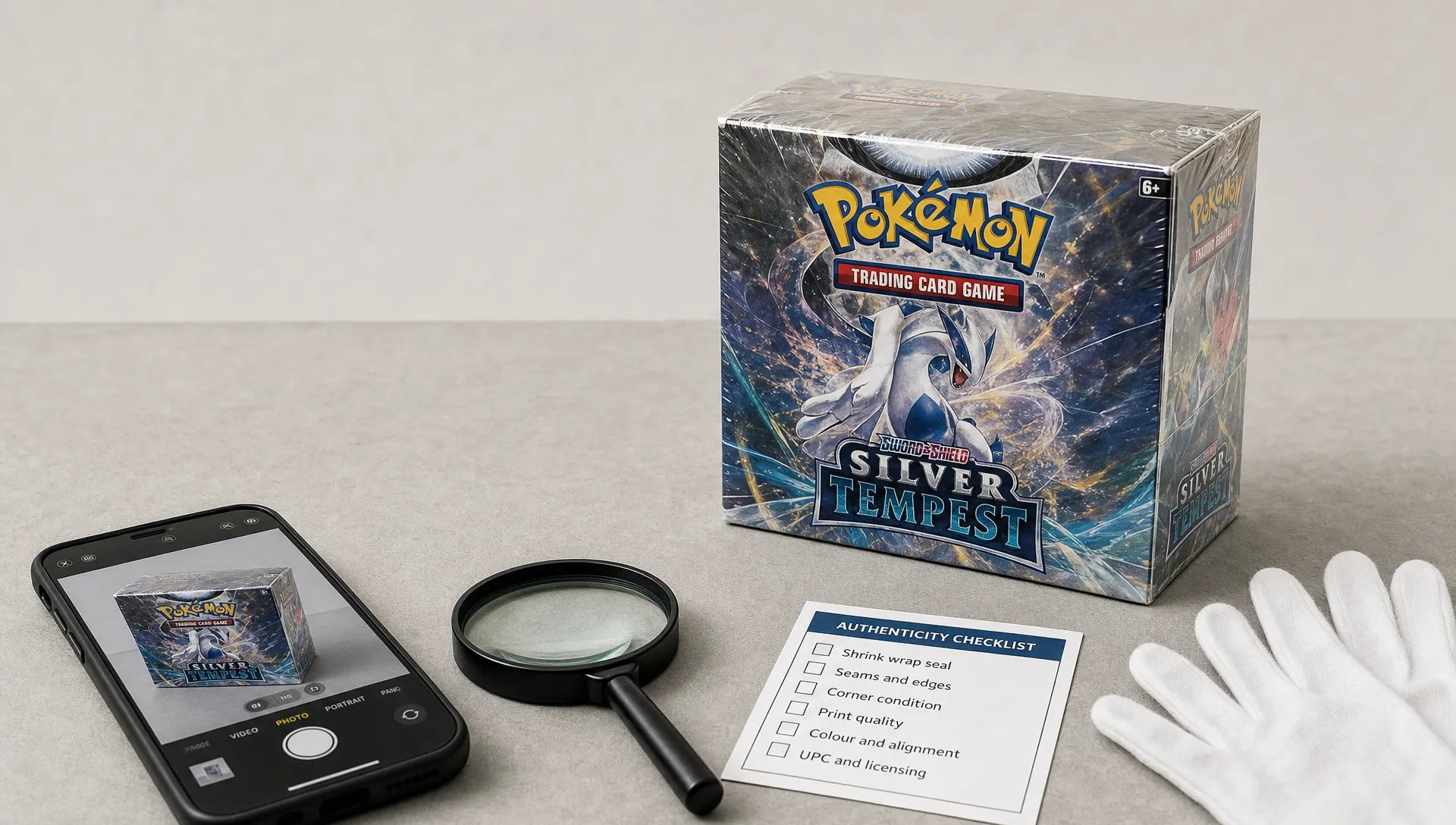
Shrink wrap is one of the most common places to spot tampering. On some sealed Pokémon products, especially many booster boxes, the wrap may include repeated Poké Ball logos. On other products, the wrap style can differ, so always compare with the exact product and region rather than assuming every item should look the same.
Watch for wrap that is unusually cloudy, wrinkled, melted, thick, or loose. A resealed box may have uneven heat marks where a heat gun was used, seams in unusual places, or a plastic texture that does not match comparable examples. The corners can also reveal problems. If the wrap bunches badly, has rough cuts, or looks like it has been folded by hand, ask for more photos.
Seams, glue, and tape residue
Look closely at edges where the product would open. Booster boxes, collection boxes, blister packs, and tins all have different factory closure methods, but glue residue, double layers of adhesive, lifting cardboard, or fresh tape over an existing seal can be concerning.
For blister products, check whether the plastic bubble looks evenly attached to the cardboard backing. If there are gaps, lifted edges, torn fibres, or cloudy glue around the pack area, the product may have been opened and pressed back down.
Booster pack crimps and edges
Loose booster packs are harder to judge than boxed sealed products because they can be weighed, searched, or removed from another product while still technically sealed. For individual packs, inspect the top and bottom crimps. Factory crimps should look even and consistent. Be wary of crimps that appear wavy, crushed, re-heated, overly shiny, or separated.
Also check whether the pack art matches the set and whether the back seam looks natural. A small nick from storage is not necessarily a reseal, but a pack that looks glued, flattened, or re-pressed deserves caution.
Missing context
A product can look fine in one photo and suspicious in another. That is why missing angles matter. If a seller shows only the front of an Elite Trainer Box but not the bottom seam, top seam, corners, or back barcode area, you do not have enough information to assess it.
Product-specific reseal warning signs
Different Pokémon products have different weak points. Use the table below as a practical checklist when reviewing photos online.
| Product type | What to inspect online | Red flags to investigate |
|---|---|---|
| Booster box | Shrink wrap, corners, bottom seam, logo pattern if expected | Loose wrap, strange seam placement, heat marks, missing or inconsistent wrap style |
| Elite Trainer Box | Outer wrap, box edges, top and bottom corners, barcode area | Torn or replaced wrap, crushed corners hidden by angles, wrap that looks hand-cut |
| Loose booster pack | Top and bottom crimps, back seam, pack art, set symbol | Re-heated crimps, glue marks, uneven sealing, stock images only |
| Sleeved booster or blister | Cardboard backing, plastic bubble, glue edges, hanger tab | Lifted plastic, torn paper fibres, cloudy glue, pack not sitting naturally |
| Tin or collection box | Outer seal, lid edge, plastic window, cardboard inserts | Broken seal, shifted contents, extra tape, missing promos, visible tampering near openings |
For booster boxes specifically, take extra care because the value can be high and the contents are easy to misrepresent. If you are shopping for a box rather than a single pack, this guide on how to buy Pokémon booster boxes online without regret goes deeper into product selection, pricing, and buyer expectations.

Ask for the right photos before you pay
If a listing is missing key angles, ask politely and specifically. A serious seller should be able to provide extra images, especially for higher-value sealed products. The goal is not to interrogate them, but to remove uncertainty before money changes hands.
Ask for clear photos of the front, back, top, bottom, all four corners, and any factory seams. For booster packs, request close-ups of the top crimp, bottom crimp, back seam, and pack art. For boxes, ask for a short video showing the item being turned in one continuous shot. A timestamp with the seller’s name or today’s date can also help confirm the item is actually in their possession.
If the seller says the product is already packed, ask them to confirm whether the photos in the listing are of the exact item being sent. For expensive products, vague answers are not good enough. You are buying the condition shown, not the idea of a sealed product.
Seller behaviour matters as much as packaging
Resealed Pokémon products often appear in places where seller accountability is low. That does not mean every private seller is unsafe, and it does not mean every store is automatically trustworthy. It means you should assess both the item and the person or business behind it.
Look for a clear trading history, consistent product categories, realistic pricing, and transparent communication. Sellers who specialise in collectibles usually understand the importance of sealed condition. Sellers who suddenly have a rare sealed collection at suspicious prices, with no proof of source and no willingness to answer questions, deserve more caution.
Payment method is another major clue. Use secure payment options that offer buyer protection where possible. Avoid being pressured into off-platform deals if you found the product on a marketplace. A small discount is not worth losing your ability to dispute a transaction.
For broader seller-level checks, including communication, policies, and reputation signals, read this guide to reputable Pokémon card sellers and their green flags and red flags.
Price can reveal risk, but not always
A low price is not proof that something is resealed. People sell quickly for many reasons, including moving house, needing cash, or clearing duplicates. However, sealed Pokémon products have active markets, and most sellers can quickly search recent prices. If a listing is far cheaper than comparable sold listings, you should ask why.
Compare sold prices, not just asking prices. Asking prices can be inflated, especially for older sealed items. Recent completed sales give you a more realistic range. For New Zealand buyers, remember to factor in shipping, GST where applicable, currency conversion, and the risk of international returns. A cheaper overseas listing can become expensive if the product arrives damaged or suspicious.
Be extra careful with bundles. A listing that includes “random sealed packs”, “mystery packs”, or a mixed lot of older and newer products can be harder to verify. Mystery products are not automatically bad, but they reduce your ability to inspect exact items before purchase.
What to do when the product arrives
Your inspection should continue after delivery. Before opening the courier satchel or box, take photos of the parcel condition. If the outer packaging is crushed, wet, or already opened, document it immediately.
Once you remove the item, compare it with the listing photos before breaking any seals. Check whether the serial details, box condition, shrink wrap, and visible contents match what you were shown. If something looks wrong, stop. Do not open the product “just to check”, because opening it can make disputes harder.
If you suspect resealing, contact the seller with calm, specific evidence. Send clear photos of the concerning areas and explain what does not match the listing. If you bought through a marketplace or payment provider, follow their dispute process and keep all messages on-platform. New Zealand buyers can also review general online shopping guidance from Consumer Protection NZ when dealing with consumer issues.
If you already opened the item before noticing a problem, document everything as clearly as possible. Photograph the packaging, pack order, contents, and any glue or seal irregularities. You may still have options, but the stronger your evidence, the better.
When a flaw is not enough to call it resealed
It is worth saying plainly: not every imperfect seal is tampering. Pokémon products can suffer from factory imperfections, shipping dents, storage wear, and shrink wrap variation. Older sealed items may show scuffs or loosened plastic simply because they have been stored for years.
The best judgement comes from patterns. One tiny corner wrinkle on an otherwise consistent product is different from loose wrap, odd seams, glue residue, missing contents, and a seller who refuses extra photos. Treat reseal checks like a risk assessment, not a single yes-or-no test.
If you are uncertain, ask collector communities for a second opinion, but do not rely on strangers alone for high-value purchases. Use their feedback alongside seller reputation, product comparisons, and payment protection.
A simple five-minute online inspection workflow
When you are tempted by a sealed Pokémon listing, run through this quick process before you buy.
- Confirm the exact product name, set, language, and product type.
- Compare the box art, pack count, and packaging style with trusted references.
- Zoom in on seams, crimps, corners, shrink wrap, glue areas, and barcode zones.
- Check the seller’s history, reviews, communication style, and return policy.
- Compare recent sold prices and ask why if the deal looks unusually cheap.
- Request fresh photos or a short continuous video if any important angle is missing.
This process will not catch every bad product, but it will filter out many avoidable mistakes. Most resealed listings rely on buyers being excited, rushed, or afraid of missing out.
Frequently Asked Questions
Can a resealed Pokémon product still contain real cards? Yes. Resealed products can contain genuine cards, fake cards, cheaper packs, searched packs, or incomplete contents. The issue is that the item is no longer factory sealed as advertised.
Are loose booster packs safe to buy online? They can be, but they carry more uncertainty than sealed boxes or sleeved products because they may have been removed from another product, weighed, or searched. Buy from sellers with strong reputations and clear photos.
Does missing Poké Ball shrink wrap always mean a booster box is fake or resealed? No. Packaging can vary by product, region, era, and release type. Missing logo wrap is a reason to investigate, not automatic proof. Compare with the exact product before deciding.
Should I open a suspicious sealed product to check the contents? Usually, no. If you suspect tampering, document the product while it is still sealed and contact the seller or platform first. Opening it can weaken your dispute evidence.
What is the biggest online red flag for resealed Pokémon products? The biggest red flag is a combination of poor photos, vague wording, unusually low pricing, and a seller who refuses reasonable requests for proof. Packaging clues matter, but seller behaviour often tells the full story.
Buy slower, collect smarter
Resealed Pokémon products are frustrating because they target the excitement that makes collecting fun. The best defence is patience. Check the listing carefully, compare the product, ask for the angles you need, and walk away when the answers do not feel right.
For a safer buying experience, choose retailers and sellers that provide clear product details, secure payment options, and transparent communication. You can also browse BigBoiSneakers for authentic sneakers, streetwear, and collectibles, with new arrivals and trending items for collectors who prefer to shop with clearer expectations.