Jordan 1 Fragment Fake Check for First-Time Buyers
Buying a hyped Fragment Jordan 1 for the first time is exciting, but it is also one of the easiest places to make an expensive mistake. Fragment pairs sit in that risky zone where demand is high, supply is limited and many listings are sold through resale channels instead of standard retail.
A good Jordan 1 Fragment fake check is not about finding one magic flaw. It is about building a case from several details: the exact model, SKU, box label, shape, materials, stitching, logos, seller behaviour and price. If too many small details feel wrong, treat that as a major warning sign.
This guide is written for first-time buyers who want a practical way to inspect a pair before paying resale money, especially if you are buying from New Zealand and cannot inspect the sneakers in person.
First, confirm which Fragment Jordan 1 you are checking
Before looking at stitching or leather, make sure you know the exact pair. “Fragment Jordan 1” can refer to a few different sneakers, and fake-check details change from model to model.
| Sneaker | Common name | Style code | First-time buyer note |
|---|---|---|---|
| Fragment Design x Air Jordan 1 Retro High OG | Fragment Jordan 1 High 2014 | 716371-040 | No Travis Scott branding or reverse Swoosh. Known for black, white and royal blue colour blocking with Fragment lightning branding. |
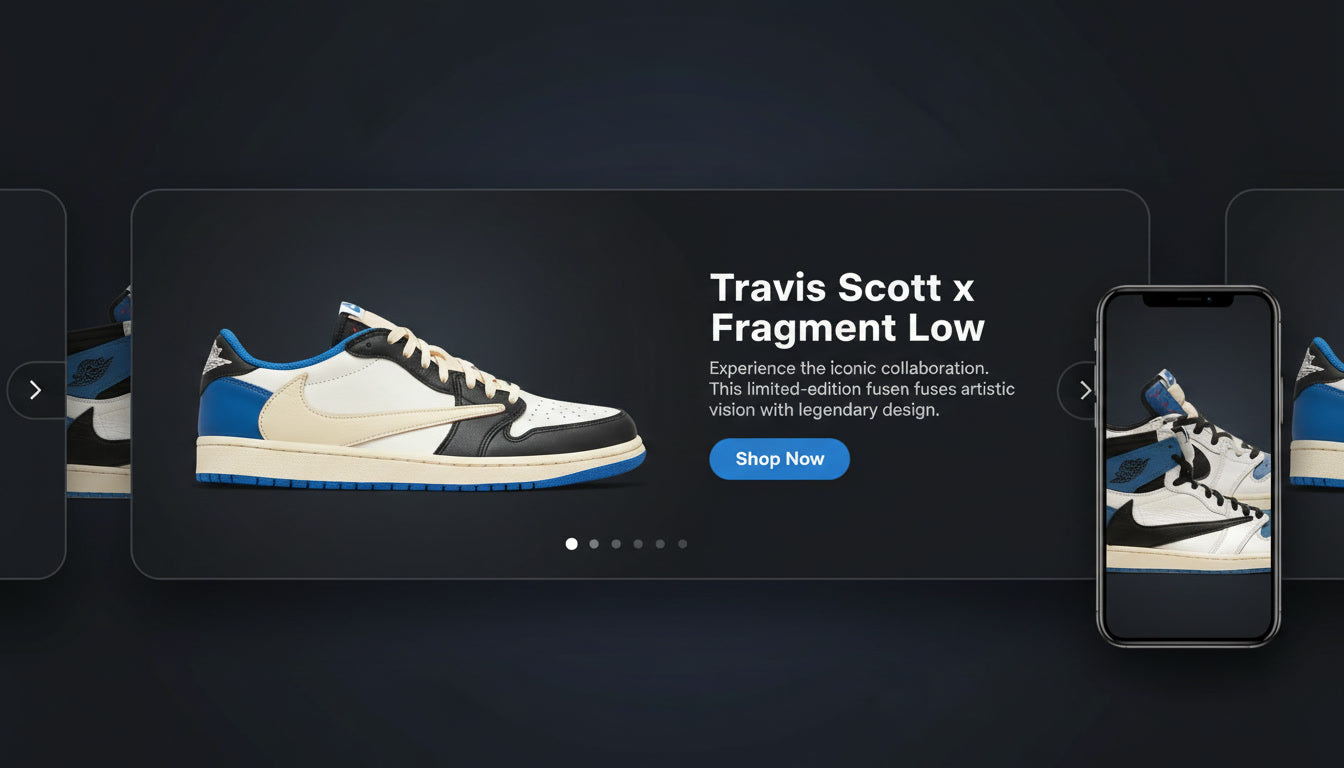
| Travis Scott x Fragment x Air Jordan 1 High OG SP | Travis Fragment Jordan 1 High | DH3227-105 | Has Travis Scott and Fragment details, including reverse Swoosh styling and collaboration branding. |
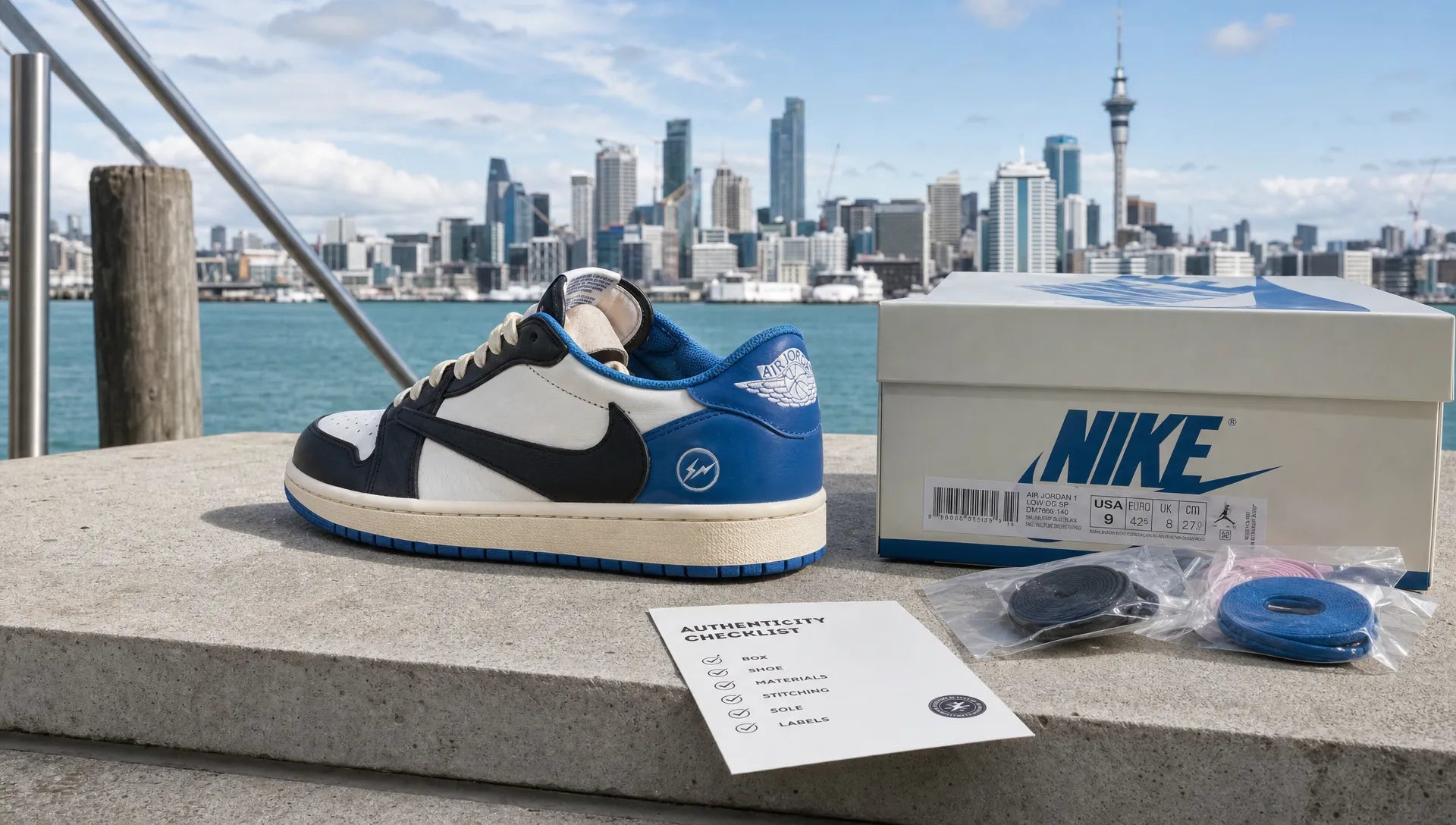
| Travis Scott x Fragment x Air Jordan 1 Low OG SP | Reverse Fragment Jordan 1 Low | DM7866-140 | Low-cut version with reverse Swoosh styling and Fragment x Cactus Jack branding. |
If a seller cannot clearly tell you which pair it is, or if the box label does not match the shoe, slow down. Confusion around names is common, but confusion around the style code is not something to ignore.
If you are still deciding between the Travis Scott x Fragment versions, BigBoiSneakers has a separate guide comparing the Travis Scott Fragment High vs Low for NZ buyers. For the Low specifically, the safest buying steps are covered in the guide to buying the Reverse Fragment Jordan 1 Low safely.
Start with the listing, not the shoe
Many first-time buyers jump straight into close-up photos, but the listing itself often tells you whether a pair is worth checking. A fake seller may avoid detail, rush the sale or use photos that do not prove they have the actual sneakers in hand.
Ask for clear, current photos of the exact pair, not screenshots from another listing. A genuine seller should be able to provide tagged photos with their name and date, plus close-ups of the box label, size tag, heel logos, Swoosh, toe box, outsole, insoles and any extra laces or accessories.
Be careful with listings that use phrases like “UA”, “rep”, “1:1”, “same factory” or “mirror quality”. These are not authentic pairs. Also be careful with listings that avoid the word authentic but imply it through hype language. If you want authentic Jordans, the seller should be willing to state that clearly and back it up.
Price is another early filter. A real Fragment Jordan 1 will usually follow resale market logic. Size, condition, box completeness, receipt history and local availability can all affect price, but a pair listed far below recent sold prices deserves serious caution. “Need gone today” can be real, but it is also a common pressure tactic.
For a wider pre-purchase process, use a broader authentic Jordans for sale checklist alongside the model-specific checks below.
Check the box label and size tag carefully
The box label is one of the easiest places to start because it should match the model, size and style code. On authentic pairs, the printed information should be sharp, correctly spaced and consistent with the pair being sold. The style code on the box should match the style code on the shoe’s internal size tag.
Look for these basics first:
- The style code matches the exact model, not just “Jordan 1”.
- The US, UK, EU and CM sizes make sense together.
- The barcode and label print are clean, not blurry or poorly aligned.
- The internal size tag matches the box label.
- The shoe, box and accessories all fit the same story of age and condition.
A correct box label does not automatically mean the pair is real. Counterfeit pairs can copy style codes. Still, a wrong label is a major problem, especially if the seller tries to explain it away as “factory variation”.
For older pairs, such as the 2014 Fragment Jordan 1 High, packaging condition should also feel believable. A perfectly fresh-looking box is not impossible if it was stored well, but it should make you inspect the rest of the pair more carefully.

Inspect the overall Jordan 1 shape
Shape is one of the strongest fake-check categories because it is difficult for counterfeit pairs to get every panel proportion right. First-time buyers often focus on small details and miss the overall silhouette.
On a real Jordan 1 High, the shoe should not look overly bulky, flat or awkward from the side. The toe box should have a natural slope rather than a chunky, inflated look. The collar should have structure without looking cartoonishly padded. From the rear, an unworn Jordan 1 High often has an hourglass-like shape, though this can soften with wear.
On the Jordan 1 Low, check the side profile, heel height and toe shape. Fakes can look too tall, too narrow, too flat or too rounded at the toe. Compare the pair against trusted reference photos of the exact same model and size range when possible, because shape can vary slightly between men’s sizes, women’s sizes and GS sizing.
Do not judge shape from one photo. Ask for side, rear, top-down and front-on shots. A fake pair can look fine from one angle and wrong from another.
Check the colour and materials under good lighting
Fragment Jordan 1 colourways rely heavily on clean contrast between white, black, blue and sometimes aged-looking midsoles depending on the model. Bad lighting can make authentic pairs look wrong, and fake pairs look better than they are.
Ask for photos in natural light if possible. The blue should not look wildly different across panels unless the lighting explains it. On Travis Scott x Fragment pairs, check that the sail or aged tones look natural rather than overly yellow or painted on. On the 2014 Fragment High, the royal blue should feel crisp and consistent with the model’s known look.
Material quality matters too. Authentic pairs should not feel like thin plastic. Leather grain can vary, so do not treat grain alone as proof, but the panels should not look overly shiny, papery or stiff in a cheap way. The midsole paint should be clean, and the outsole should not have sloppy edges or messy moulding.
If you are inspecting in person, smell can help but should never be your only test. A harsh chemical smell may be a warning sign, but older stored pairs, cleaning products and packaging can also affect smell.
Study the Swoosh, Wings logo and Fragment branding
The Swoosh is a key detail on every Jordan 1 Fragment fake check. On authentic pairs, the Swoosh should have the correct length, curve, thickness and placement for that model. Fakes often get the angle slightly wrong, place the tip too high or too low, or use a shape that looks too thick through the middle.
For the 2014 Fragment Jordan 1 High, remember that it does not have Travis Scott reverse Swoosh branding. If a listing mixes Fragment 2014 language with Travis-style details, the seller may not know what they have, or they may be trying to confuse a new buyer.
The Wings logo should be sharp and correctly placed. Look at the spacing, the ball-and-wings detail and how the logo sits on the collar panel. Blurry edges, poor embossing, strange placement or uneven pressure can all be red flags.
Fragment’s lightning bolt branding is another important area. On authentic pairs, it should look clean and intentional, not randomly stamped or poorly centred. On fake pairs, the circle, bolt shape, depth or placement can be off. Do not rely only on the stamp, since some fakes copy it well, but combine it with the Swoosh, shape and material checks.
Pay attention to stitching and construction
Stitching is not about demanding perfection. Even authentic Nike pairs can have small factory inconsistencies. What you are looking for is whether the construction quality matches a premium, authentic release.
Check the stitching around the Swoosh, toe box, heel panels, collar, tongue and midsole. Lines should generally be even, with consistent spacing and no obvious loose threads or messy overlaps. Watch for stitches that wander away from the panel edge, especially around curved areas like the Swoosh.
Glue marks can happen on real sneakers, but heavy glue stains, uneven midsole joins or sloppy panel alignment should make you pause. On high-value pairs, poor construction is not just a cosmetic issue. It can be a clue that you are not looking at a legitimate pair.
Travis Scott x Fragment details need model-specific checks
The Travis Scott x Fragment Jordan 1 High and Low are often faked because they are popular with both sneaker collectors and casual buyers. These pairs need extra care because they include more collaboration details than the 2014 Fragment High.
Check that the reverse Swoosh is on the correct side and has the correct shape for the specific model. Compare the medial and lateral sides, because counterfeit pairs may focus on the obvious reverse Swoosh but make mistakes on the other side.
Heel branding should also match the correct model. The Cactus Jack and Fragment details should be clean, correctly placed and consistent from left shoe to right shoe. The tongue tags, insole graphics and any hidden branding should also match authentic references.
Accessories matter. Extra laces, paper, box style and hangtags can affect value and confidence. Missing accessories do not always mean fake, especially on used pairs, but a seller should be honest about what is included.
Common red flags first-time buyers should not ignore
One small flaw might not be enough to reject a pair, but several red flags together usually tell the real story. Be especially careful when seller behaviour and product details both feel wrong.
Watch for these warning signs:
- The seller refuses to provide new tagged photos.
- The price is far below realistic resale value with no clear reason.
- The style code does not match the shoe or box.
- The pair is described as “authentic” but also “UA” or “same factory”.
- The seller rushes you to pay through an unsafe method.
- The photos hide the size tag, heel branding or box label.
- The shoe shape looks wrong from multiple angles.
- The listing uses stock images only.
If you feel pressured, step away. Real pairs appear again. Losing one deal is better than being stuck with a fake.
Buying safely in New Zealand
For NZ buyers, the biggest challenge is distance. Many rare Jordan 1 Fragment listings are overseas, which means you may be relying on photos, international shipping and seller communication. That makes your process more important, not less.
Use secure payment methods that offer buyer protection where possible. Avoid bank transfers to unknown sellers, especially for high-value sneakers. If you are buying from a marketplace, understand the dispute process before you pay. If you are buying from a private seller, ask for a video call or fresh photo set if anything feels unclear.
Local buying has advantages because you may be able to inspect the pair before payment. Still, do not let proximity replace caution. Meet safely, check the pair in good light and compare the shoe, size tag and box before handing over money.
The safest route for a first-time buyer is usually to buy from a trusted sneaker retailer or a seller with a strong, verifiable history. BigBoiSneakers focuses on authentic sneakers, streetwear and collectibles, with secure payment options and detailed product information, so you can spend less time worrying about basic legitimacy and more time choosing the right pair.
Frequently Asked Questions
What is the first thing to check on a Fragment Jordan 1? Start with the exact model and style code. The 2014 Fragment Jordan 1 High, Travis Scott x Fragment High and Travis Scott x Fragment Low all have different details, so you need to know which pair you are checking before judging logos or materials.
Can a real Fragment Jordan 1 have small glue marks or stitching flaws? Yes, minor factory flaws can exist on authentic pairs. The problem is when flaws appear across multiple areas, such as poor shape, wrong label details, messy logos and suspicious seller behaviour.
Is a low price always proof that a Jordan 1 Fragment is fake? Not always, but it is a serious warning sign. Condition, missing accessories and urgent sales can affect price, but a pair far below market value should be checked very carefully.
Can I legit check a Fragment Jordan 1 from photos only? You can reduce risk with detailed photos, but photos are not perfect. Ask for fresh tagged images, multiple angles, box label shots and size tag photos. For expensive pairs, consider a professional legit check or buy from a trusted retailer.
Do all Fragment Jordan 1 pairs have a reverse Swoosh? No. The 2014 Fragment Design x Air Jordan 1 High does not have Travis Scott reverse Swoosh styling. Reverse Swoosh details apply to the Travis Scott x Fragment collaborations, not the original Fragment Jordan 1 High.
Make your first Fragment Jordan 1 purchase with confidence
A proper fake check is about patience. Confirm the exact model, compare the style code, study the shape, inspect the logos and judge the seller as carefully as the shoe. If anything feels rushed, vague or too good to be true, trust that instinct.
When you are ready to shop, explore authentic sneakers and streetwear at BigBoiSneakers. Whether you are chasing Jordans, Yeezys, Dunks or collectibles, buying from a trusted source is the simplest way to avoid the stress of a risky resale deal.