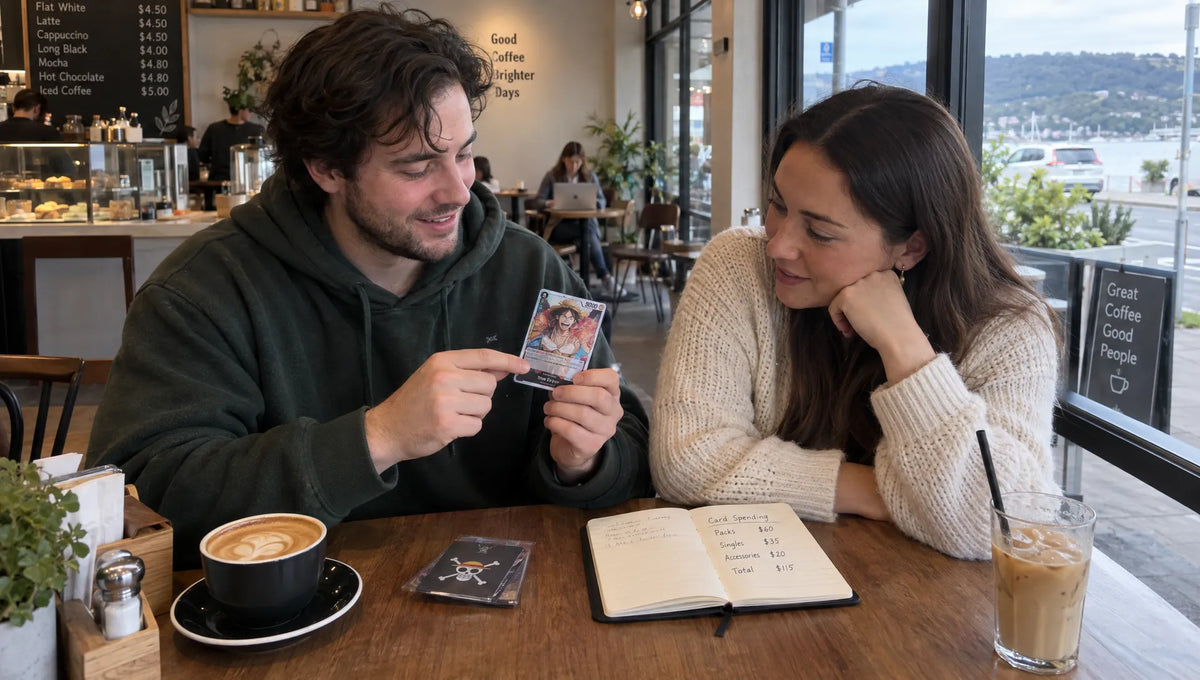
One Piece TCG Card List and Price Guide for Set Collectors
A useful One Piece TCG card list price guide should help you identify the cards you need, distinguish standard prints from variants and calculate what finishing a set could cost in New Zealand dollars. A page of expensive chase cards only answers part of that problem.
For set collectors, the practical approach is to combine Bandai’s official checklist with recent sales for matching cards. Below, you’ll find a set directory, a collection-tracking template and a method for turning overseas prices into a realistic NZ buying budget. All worked prices are illustrative, not current market quotes.
Find the official card list for your set
Start with the official Bandai One Piece Card Game card list. Select the relevant release, then check individual card numbers and available artwork. Use this as your reference for card identity, rather than relying on a seller’s title alone.
These selected main booster sets provide useful starting points. They are not a complete release catalogue.
| Set code | English set name |
|---|---|
| OP-01 | Romance Dawn |
| OP-05 | Awakening of the New Era |
| OP-08 | Two Legends |
| OP-09 | Emperors in the New World |
| OP-10 | Royal Blood |
| OP-12 | Legacy of the Master |
Other product families include extra boosters, premium boosters, starter decks and promotional releases. Don’t assume every card featuring the same character belongs to the same set.
A card’s printed number identifies the underlying card, but not necessarily its artwork or release version. Reprints and alternate-art versions can share that number, so inspect the image and product information too.
Build a One Piece TCG card list price tracker
Before researching values, decide what “complete” means for your collection. A standard numbered set, a set including alternate arts and a character collection are different projects with different budgets.
Define your scope in one sentence, such as: “One English standard-art copy of each numbered OP-01 card.” Decide separately whether promotional cards, special treatments and DON!! cards belong in your checklist.
A spreadsheet can start with these genuine OP-01 card examples. The ownership figures are placeholders, not a claim about your collection.
| Card number | Card name | Version to track | Owned | Target price, NZD |
|---|---|---|---|---|
| OP01-016 | Nami | English standard art | 0 | Research required |
| OP01-025 | Roronoa Zoro | English standard art | 0 | Research required |
| OP01-120 | Shanks | English standard art | 0 | Research required |
Add columns for condition, recent sold range, shipping, source and date checked. Give each alternate art its own row instead of combining all versions under one card number.
For inexpensive cards, track bundle costs as well as individual values. Buying several missing commons from one seller may cost less overall than choosing the cheapest separate listing for each one.
Separate standard cards, alternate art and reprints
A One Piece TCG card list price entry is only useful when it describes the exact version being valued. A standard-art card and a sought-after alternate art can have very different markets despite sharing a name and number.
Match these details before comparing prices:
- Identity: Character name and complete printed card number.
- Printing: Standard art, alternate art, special treatment, promotional version or reprint.
- Language: English, Japanese or another edition.
- Condition: Comparable wear, surface quality and any disclosed damage.
- Format: Ungraded single or a graded card from a specified grading company.
Rarity labels such as R, SR and SEC help organise a checklist, but they are not a price scale. Character popularity, artwork, availability and demand for gameplay also affect what buyers pay.
English and Japanese editions need separate entries. Neither language is automatically worth more across every card, and an overseas price is not a direct NZ comparison without accounting for delivery and currency.
If you also intend to play, check the current rules for your region before buying a different-language version. A collecting preference and tournament eligibility are separate questions.
Use completed sales, not just asking prices
For your One Piece TCG card list price range, begin with recent completed sales for the matching version. An active listing shows what a seller wants, not what a buyer has paid.
On eBay, search the card number alongside the character, language and artwork description, then apply the sold-items filter. Inspect each result rather than treating every search match as comparable.
Where possible, collect three to five recent sales in similar condition. Exclude bundles, different artworks, damaged copies and graded cards when valuing an ungraded single. A sale accepted through Best Offer may not publicly reveal the actual accepted amount, so don’t assume the displayed figure is precise.
TCGplayer can provide another reference for English singles. Check whether the figure you are reading is a market indicator, a seller’s listing or another price measure. Those figures answer different questions.
Record a range and the date checked. If matching sales are scarce, label the estimate low confidence rather than presenting one unusual transaction as the market value. Widen the search period cautiously, since older sales may reflect different supply or demand.
Convert overseas values into an NZ buying budget
Keep a landed-cost column beside each One Piece TCG card list price estimate. This separates the card’s comparison value from what you would actually spend to receive it in New Zealand.
For illustration, suppose a matching card is listed at US$20 and you use a hypothetical exchange rate of NZ$1.70 per US$1.
| Cost component | Illustrative amount |
|---|---|
| Card price after conversion | NZ$34 |
| Shipping to New Zealand | NZ$12 |
| Subtotal before applicable tax or payment fees | NZ$46 |
That NZ$34 overseas card is not automatically cheaper than a NZ$42 local listing. Compare delivered totals using the exchange rate your payment provider will actually apply.
Check whether checkout includes GST and whether other charges could apply. New Zealand Customs’ online shopping guidance explains the relevant import considerations.
For multi-card orders, allocate combined shipping consistently across your tracker. You can also keep a separate order-level shipping total, provided you don’t accidentally count it twice.

Assess condition before adding a value
Inspect the front and back under clear light. Look for whitening along edges, worn corners, scratches, dents, creases and surface marks. Sleeves can hide some defects, so ask for clear unsleeved photographs when the card’s value justifies closer inspection.
“Near mint” is a seller’s condition description, not a guarantee of a particular grading result. A clean-looking card can still have surface or manufacturing issues that are difficult to spot in listing photos.
Treat any One Piece TCG card list price for a graded copy as a separate category from its ungraded equivalent. Match the grading company and numerical grade before using a slabbed sale as a comparison.
Work out whether grading fits your collection
Grading adds costs before it adds any potential resale premium. Account for the service fee, insured shipping, possible intermediary charges and the risk of receiving a lower grade than expected.
Compare the likely sale proceeds after those costs with what the card could sell for ungraded. A high-grade listing alone is not evidence that submitting your copy will be profitable.
For a binder set, grading may also work against your collecting goal by separating one card from the rest. Protective storage can be the more practical choice when authentication or resale is not your priority.
Budget for missing singles before buying another box
Once your checklist is established, add up the missing cards using realistic condition-matched targets. Keep the standard set subtotal separate from optional alternate arts, so one expensive variant does not obscure the cost of finishing your original goal.
Use your One Piece TCG card list price totals to compare the remaining singles budget with a sealed box. A booster box offers the opening experience and random cards, not a guaranteed selection of your missing numbers.
Early in a collection, opening packs can add many cards you don’t own. Later, duplicates can make targeted singles a more predictable way to close gaps. Avoid treating a valuable chase card as an expected return from your next box.
Match sealed products to the right checklist
For collectors working on the tenth main expansion, the Bandai One Piece Card Game Royal Blood OP-10 English Booster Box is relevant to an English Royal Blood checklist. Check the current product details and price against your collection budget before deciding between sealed packs and singles.
The 2025 Bandai One Piece Legacy of the Master Booster Box (OP-12) is another set-specific option. This listing is for a Japanese box, so keep it separate from an English OP-12 completion plan.
Neither box should be treated as a guaranteed route to particular cards. Product language and release code are more useful buying checks than recognising the character on the packaging.
Keep your collection total useful
A collection tracker should distinguish three amounts: what you paid, an estimated resale value and the cost of replacing the cards today. Those numbers will rarely be identical.
Your purchase total includes historical shipping and other costs. Estimated resale value should reflect condition and realistic selling circumstances, including fees where applicable. Replacement cost answers what you would spend to buy comparable copies now.
Update your One Piece TCG card list price tracker before a significant purchase or sale, rather than repricing every common each week. Focus attention on expensive missing cards, thinly traded variants and items whose recent sales have changed noticeably.
Don’t assume the sum of individual retail listings is what a buyer will pay for the entire collection. A buyer taking everything together may expect a discount, particularly where the collection includes duplicates or low-demand cards.
Frequently asked questions
Where can I find a complete One Piece card list? Use Bandai’s official card database and select the relevant release. Check the artwork options and release information, not just the card number. English and Japanese release coverage should be checked separately.
How much are One Piece TCG cards worth? There is no single set-wide value. Identify the exact printing, language and condition, then compare recent matching sales. Common cards, alternate arts, promotional cards and graded copies should not share one pricing assumption.
Can I price a card using only its number? The number is a strong starting point, but it may be shared by standard art, alternate art and reprints. Match the image, language, finish and release version before recording a value.
What is a master set? Collectors use the term differently. It can include standard cards, alternate arts and other variants, but the boundaries are not universal. Write down your inclusion rules before budgeting or buying a collection advertised as complete.
Should I buy singles or booster boxes to finish a set? Singles are generally the more predictable option when you need specific cards. Boxes suit collectors who value opening packs and accept duplicates. Compare your remaining checklist cost with the delivered box price rather than assuming a valuable pull.
Choose the next addition from your checklist
Identify the release, confirm the language and price the missing cards before buying. If sealed collecting is part of your plan, browse the One Piece collection at BigBoiSneakers and match each product to the checklist you are building. Keeping standard-set completion separate from optional chase cards makes the next purchase easier to judge.