Raw vs Graded Pokémon Cards: Which Should You Buy?
If you are shopping for Pokémon singles online, one of the first choices you will face is whether to buy a raw card or a graded card. Both can be smart buys, but they suit different collectors.
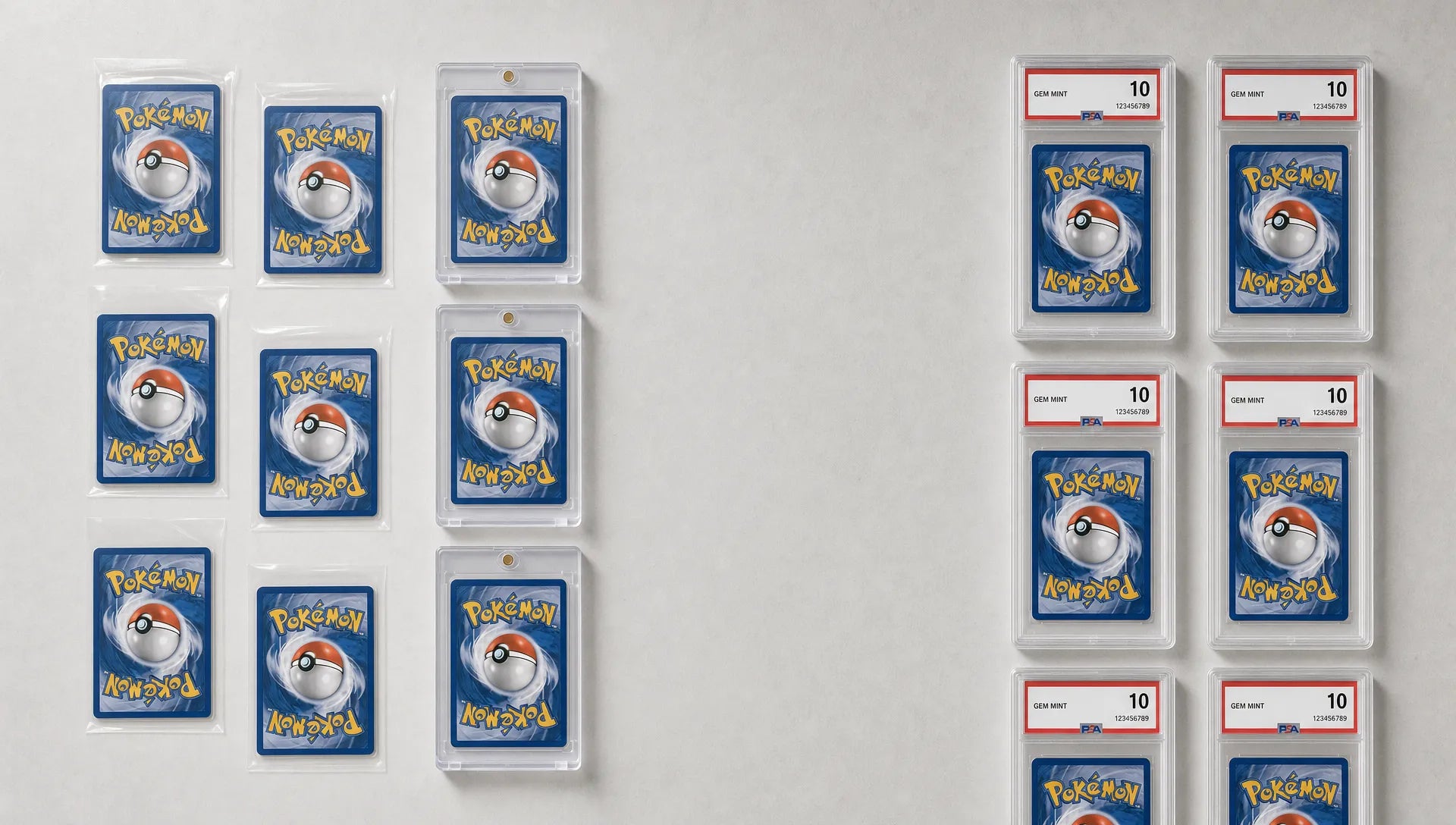
A raw card gives you flexibility, usually at a lower upfront price. A graded card gives you more certainty, better display protection, and often stronger resale clarity. The best option depends on your budget, the card value, your risk tolerance, and whether you are buying for a binder, a display shelf, a gift, or a long term collection.
For New Zealand collectors, the decision matters even more because shipping, currency conversion, and returns can make mistakes expensive. Here is how to compare raw vs graded Pokémon cards before you buy.
What does raw mean in Pokémon cards?
A raw Pokémon card is any card that has not been professionally graded and encapsulated. It might be freshly pulled, stored in a penny sleeve and top loader, kept in a binder, or sold loose by a collector.
Raw does not mean bad. Many excellent cards are raw. It simply means the card condition has not been independently assessed by a grading company.
The challenge is that raw condition is subjective. One seller might call a card near mint because the front looks clean. Another buyer might notice whitening on the back edge, a tiny surface dent, a print line, or corner wear that changes the value completely.
Raw cards are usually best when you can inspect strong photos, trust the seller, and understand what condition issues to look for.
What does graded mean in Pokémon cards?
A graded Pokémon card has been reviewed by a third party grading company, assigned a condition grade, labelled, and sealed inside a hard plastic case, often called a slab.
Popular grading companies include PSA, CGC Cards, and Beckett. Each has its own scale and standards, but most collectors focus heavily on the final grade. PSA, for example, publishes its own grading standards, which explain how centring, corners, edges, and surface can affect the number a card receives.
A graded card usually gives buyers three things:
- More confidence in condition
- A protective case for storage and display
- Easier price comparison against sold listings for the same card and grade
That said, grading is still an expert opinion. A grade does not guarantee future value, and the market can price the same card very differently depending on the grading company, the grade, the set, demand, and timing.
The biggest difference: upside vs certainty
The raw vs graded decision comes down to a simple tradeoff.
Raw cards often have more upside because you might buy a clean card for less than its graded value. If the card later grades well, the value may increase. But raw cards also carry more risk because you might miss damage, overestimate condition, or discover the card is not as clean as advertised.
Graded cards reduce uncertainty. You can compare a PSA 9 to other PSA 9 sales, or a CGC 10 to other CGC 10 sales. This makes buying and selling more straightforward. But you usually pay for that certainty upfront, especially with popular chase cards, vintage holos, and low population high grades.
A good rule of thumb is this: buy raw when you are comfortable judging condition, and buy graded when the card is expensive enough that certainty matters.
When buying raw Pokémon cards makes sense
Raw cards are a great choice for many collectors, especially if your goal is enjoyment rather than maximum resale precision.
You should consider buying raw when:
- You are building a binder and want the art, nostalgia, or set completion more than a slab.
- The card is affordable enough that minor condition differences will not ruin the purchase.
- You want a playable card for casual decks or display pages.
- You enjoy the grading hunt and are willing to inspect cards carefully.
- The seller provides clear photos of the front, back, corners, edges, and surface.
- The price leaves room for risk instead of assuming the card is a guaranteed gem mint candidate.
Raw cards are also easier to store in binders and more fun to handle. For modern cards, many collectors prefer raw copies because they can collect more artwork for the same budget instead of paying a premium for one graded slab.
The key is not to treat every clean looking raw card as a future grade 10. Most raw cards, even good ones, will not grade perfectly.
When buying graded Pokémon cards makes sense
Graded cards are best when condition, authenticity, and presentation matter more than getting the lowest possible price.
You should consider buying graded when:
- The card is high value and a condition mistake would be costly.
- You are buying vintage where edge wear, scratches, dents, and binder damage are common.
- You want display quality for a shelf, desk, or collection wall.
- You are buying a gift and want a card that feels complete and protected.
- You may resell later and want easier market comparison.
- You prefer certainty over the chance of finding an underpriced raw card.
Graded cards can also be useful for collectors who are still learning condition. Instead of guessing whether a vintage holo is lightly played or near mint, you can buy the grade that suits your budget and compare it against other sold copies.
Raw vs graded Pokémon cards at a glance
| Factor | Raw Pokémon cards | Graded Pokémon cards |
|---|---|---|
| Upfront price | Usually lower | Usually higher for strong grades |
| Condition certainty | Depends on seller photos and your inspection | More standardised through the grade |
| Display appeal | Best in binders or top loaders | Strong for shelves, cases, and gifts |
| Storage | Compact and easy to organise | Bulkier but better protected |
| Resale comparison | Harder because condition varies | Easier when comparing same card, company, and grade |
| Risk | Higher risk of missed flaws or overgrading | Lower condition risk, but slab and label still need checking |
| Best for | Binders, budget collecting, grading candidates | High value cards, vintage, display, long term collecting |

Do not price raw cards like guaranteed grade 10s
One of the most common buying mistakes is comparing a raw near mint listing to a PSA 10 or CGC 10 sale.
A raw card might look beautiful in photos and still grade lower than expected. Tiny surface dents, back edge whitening, off centre printing, scratches visible only under angled light, and print defects can all affect the final grade. Even pack fresh cards can have flaws straight from the factory.
When valuing a raw card, compare it to raw sold listings in similar visible condition. If you are considering grading, also compare lower graded examples, not just perfect 10s. A realistic pricing check should ask what happens if the card grades an 8 or 9 instead of a 10.
For a deeper pricing process, use our Pokémon card price checklist to compare condition, rarity, demand, and sold listings before you commit.
The grade premium curve: why 10s can get expensive
The difference between a grade 9 and a grade 10 can be massive on some cards, especially popular modern chase cards and vintage holos. That gap usually exists because the market believes perfect or near perfect examples are harder to find.
But the premium is not always worth paying. Sometimes a grade 9 looks nearly identical in a display case and costs far less. Sometimes a lower grade vintage card has more character and gives you access to a card you could not otherwise afford.
Think about grades as buying tiers:
| Grade type | What it often suits | Buyer mindset |
|---|---|---|
| Raw clean copy | Binder collecting or grading potential | I want the card and accept condition risk |
| Grade 7 to 8 | Vintage display on a tighter budget | I want authenticity and protection without chasing perfection |
| Grade 9 | Strong display and resale clarity | I want a high grade but not always the top premium |
| Grade 10 | Premium collecting and registry style goals | I am comfortable paying for top condition scarcity |
This does not mean every grade 10 is a good buy. Population reports can grow as more copies are graded, hype can cool, and card values can move both up and down. Buy because the card fits your collection first.
How to inspect raw Pokémon cards before buying
If you are buying raw, photos are everything. A single front photo is not enough for any card with meaningful value.
Ask for or look for:
- Clear front and back photos in good lighting
- Close ups of all four corners
- Edge photos showing whitening, nicks, or peeling
- Angled surface photos to reveal scratches, dents, and print lines
- Confirmation of the exact set, number, language, and variant
- Photos outside sleeves if safe and reasonable, since sleeves can hide flaws
Be cautious with phrases like pack fresh, minty, or grade ready. They might be honest descriptions, but they are not substitutes for evidence. A card can be pack fresh and still have poor centring or print defects.
You should also confirm the exact version of the card. A reverse holo, promo, Japanese print, English print, first edition stamp, or reprint can change value significantly. If you are unsure how to avoid fakes and misrepresented listings, our guide on buying authentic Pokémon cards safely covers the key checks before you pay.
How to judge graded Pokémon card listings
Graded cards are easier to compare, but they are not risk free. Fake slabs, swapped labels, damaged cases, and misleading photos can still happen.
Before buying a graded card, check that the label details match the card exactly. Look at the set name, card number, language, variant, and grade. If the grading company provides a certification lookup, compare the cert details to the listing. Some databases may include images, which can help confirm the card and slab match.
Also inspect the slab itself. Scratches on the case may not affect the card grade, but they can affect display appeal. Cracks, tampering marks, cloudy plastic, or poor photos should make you slow down.
For expensive cards, do not rely on the grade alone. Compare recent sold prices for the same grading company and grade. A PSA 10, CGC 10, and Beckett 9.5 are not always priced the same, even when the card is identical.
Should you buy raw and grade it yourself?
Buying raw and submitting cards for grading can be exciting, but it is not automatically cheaper.
You need to account for grading fees, shipping, insurance, currency conversion, turnaround time, and the chance that the grade comes back lower than expected. For New Zealand collectors submitting overseas, shipping logistics can matter a lot. If the card is not valuable or personally important, the total cost may outweigh the benefit.
Grading your own raw cards makes the most sense when the card is genuinely clean, the value jump between raw and graded is meaningful, and you are happy to keep the card even if the grade is lower than hoped.
It makes less sense when you are relying on a perfect grade just to break even.
NZ buyer considerations: shipping, returns, and local trust
For collectors in New Zealand, the seller location can change the risk profile. Buying from overseas can open up more inventory, but it can also add delivery time, currency conversion, possible import costs, and harder returns if something goes wrong.
Buying locally can make communication, shipping, and issue resolution easier. This is especially useful for raw cards, where condition disputes are more common. If a seller understands local expectations and provides clear listing photos, that can be worth more than saving a few dollars from an unknown overseas listing.
If you are still deciding between singles, sealed products, graded cards, or gifts, the Pokémon NZ buying guide can help you choose the right product type for your goal.
Quick decision guide: which should you buy?
Choose raw Pokémon cards if you want more cards for your budget, enjoy binders, can inspect condition well, and accept that not every clean card will grade highly.
Choose graded Pokémon cards if you want stronger certainty, better display protection, easier resale comparison, or are buying a card where condition differences can seriously affect price.
The best collectors often buy both. They keep raw copies for binders and artwork, then buy graded versions of their favourite chase cards, vintage holos, or personal grails.
The real question is not whether raw or graded is better. It is whether the card, condition, price, and purpose all match.
Frequently Asked Questions
Are graded Pokémon cards always worth more than raw cards? Not always. A high grade can add value, but a low grade may not sell for much more than a clean raw copy. The card itself, the grading company, the grade, demand, and recent sold prices all matter.
Is it better to buy PSA, CGC, or Beckett graded cards? It depends on the card and your collecting goal. PSA often has strong market recognition, CGC and Beckett also have dedicated buyers, and price differences can vary by card. Always compare sold listings for the same company and grade.
Should beginners buy raw or graded Pokémon cards? Beginners often do well with affordable raw cards for binders and a few graded cards for favourite characters or higher value purchases. This gives you experience without putting too much money into one risky buy.
Can a raw Pokémon card be fake? Yes. Raw cards can be counterfeit, altered, or misrepresented. Check print quality, card texture, font, holo pattern, back colour, seller reputation, and exact card details before buying.
Is a PSA 9 better value than a PSA 10? Often, yes, especially if you care about display more than owning the highest grade. A PSA 10 may carry a large premium, while a PSA 9 can look excellent and cost less. The right choice depends on your budget and goals.
Should I crack a graded card out of its slab? Usually, only if you have a clear reason, such as binder collecting, regrading, or crossover submission. Cracking a slab can damage the card and removes the certainty that made the graded card valuable in the first place.
Build your Pokémon collection with confidence
Whether you are chasing a binder copy, a display slab, or a special gift, take your time with condition, authenticity, and price comparisons. Raw cards reward careful inspection, while graded cards reward patience and disciplined buying.
When you are ready to explore authentic collectibles, sneakers, and streetwear in one place, browse Pokémon cards and collectibles at BigBoiSneakers and choose the pieces that genuinely fit your collection.