How to Tell if a Collectible Seller Is Trustworthy
Buying collectibles online is part treasure hunt, part risk assessment. The same search that turns up a grail pair of Jordans, a sealed Pokémon booster box or a limited streetwear drop can also turn up sellers using borrowed photos, vague descriptions or payment methods that leave you exposed.
A trustworthy collectible seller does not need to be perfect. They do need to be transparent, consistent and easy to verify. Before you pay, your job is to look for evidence that the seller owns what they are selling, understands the item, prices it realistically and has a clear process if something goes wrong.
This guide gives you a practical way to assess collectible sellers across sneakers, trading cards, streetwear, figures and other sought-after items, especially if you are buying online in New Zealand.
Start with the trust signals that are hard to fake
Scam listings often rely on speed. They push urgency, make the deal feel too good to miss and discourage careful checks. A reliable seller should make it easy for you to slow down and verify the basics.
Use this quick table before going deeper:
| What to check | Trustworthy sign | Warning sign |
|---|---|---|
| Seller identity | Clear store name, contact details and consistent profiles | New account, no business details or changing usernames |
| Product photos | Original photos from multiple angles | Stock photos only or images found elsewhere online |
| Item description | Specific size, condition, edition, flaws and inclusions | Vague wording like “rare” with no details |
| Pricing | Close to recent market sales | Far below market with pressure to pay fast |
| Payment | Secure checkout, card payment or protected platform | Bank transfer only, crypto or “friends and family” payments |
| Policies | Shipping, returns and dispute process are visible | No policy, no tracking or “no refunds ever” language |
| Reviews | Detailed reviews across time | Sudden review spikes or only generic praise |
A single weak signal does not always mean the seller is dishonest. For example, an individual collector selling one card may not have a polished store. The problem is a pattern. If the seller has poor photos, a rushed payment request, no track record and a price that makes no sense, walk away.
Verify who is actually selling the item
A trustworthy collectible seller should be identifiable. For an online store, look for a real business presence, clear contact options, secure checkout and policies written in plain language. For marketplace sellers, check the account age, past listings, feedback history and whether the seller’s name or handle is consistent across platforms.
In New Zealand, you can also look for basic business credibility. A seller claiming to be a local company should be willing to provide enough detail for you to verify them. Not every small seller will have the same setup as a larger retailer, but a serious business should not hide who they are.
Check whether the website feels complete. Trustworthy stores usually have product categories, contact pages, shipping information, return information and secure payment options. A store with only a few high-value items, no real branding and copy-pasted text from other sites deserves extra scrutiny.
For extra safety, compare what the seller says with official consumer guidance. Consumer Protection NZ recommends checking seller details, total costs, delivery terms and payment safety before buying online. That advice matters even more when the product is limited, expensive or hard to replace.
Inspect the product evidence, not just the promise
Collectibles need proof. A seller saying “100 percent authentic” is not enough on its own. You want photos, item details and condition notes that match the exact product being sold.
For sneakers, ask for clear photos of the box label, size tag, outsole, stitching, insole, shape and any accessories. If the shoes are pre-owned, the listing should show wear points like heel drag, creasing, sockliner wear and outsole condition. For high-demand models such as Jordan, Nike Dunk or Yeezy releases, compare the product against known authentic pairs from trusted retailers or established resale references.
For Pokémon cards, the evidence depends on the item type. Singles should have front and back photos, close-ups of corners and edges, condition notes and clarity about the exact set, number and variant. Sealed products should show all sides of the packaging, seal lines, wrapping texture and any dents or tears. If you are specifically buying sealed TCG products, this guide on how to spot resealed Pokémon products online goes deeper into packaging clues.
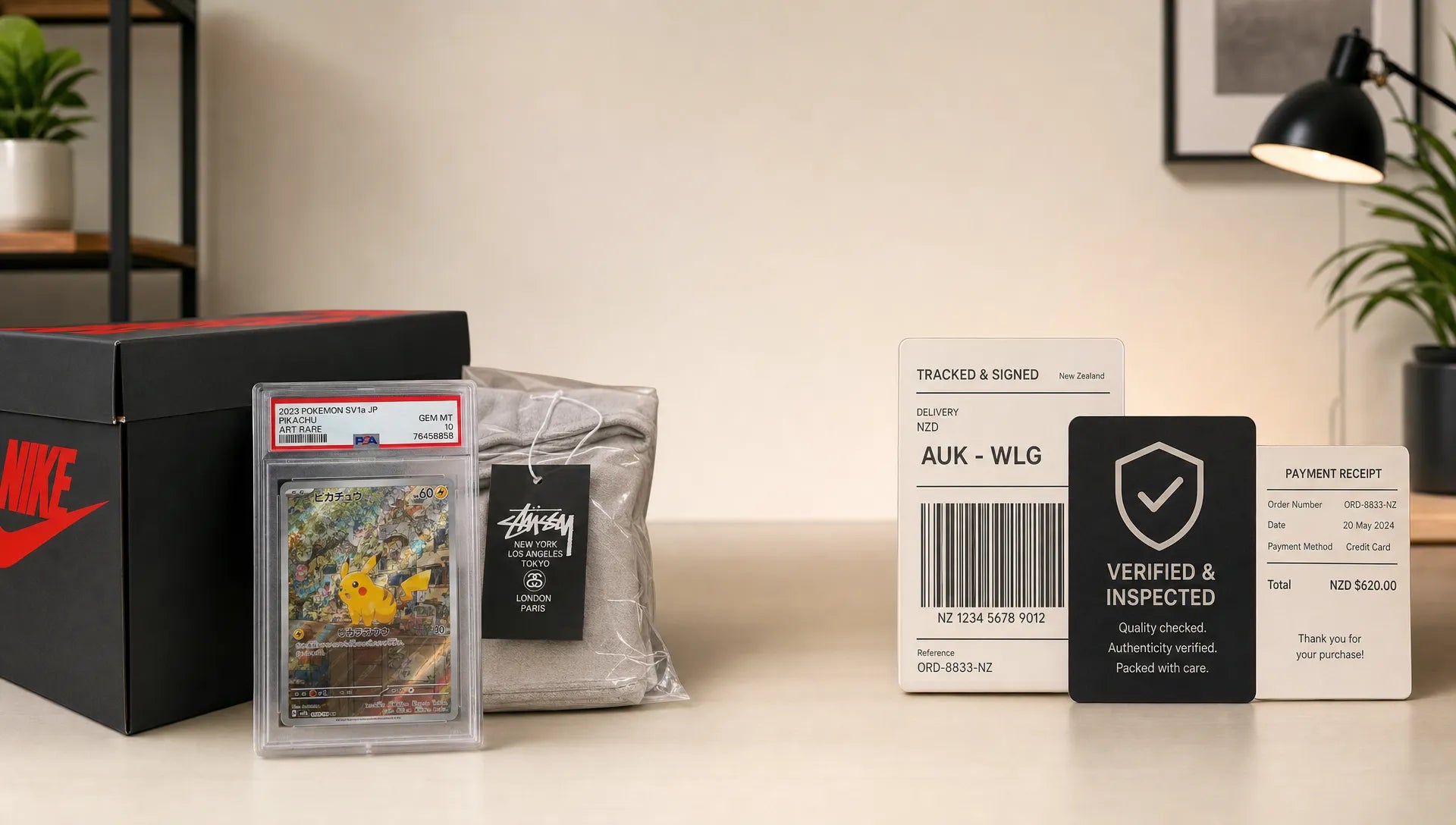
For graded cards, confirm the grading company, certificate number and label details. Most major grading companies provide online certification lookups. The certification number should match the card, grade and label shown in the listing. If the seller refuses to show the cert number on an expensive graded card, that is a reason to pause.
For streetwear and apparel, product evidence should include size tags, wash tags, stitching, prints, embroidery, packaging and proof of purchase if available. Fakes often get small details wrong, so photos should be sharp enough to inspect.
Check whether the price makes sense
A bargain is not automatically a scam, but collectibles have visible market behaviour. If a product is rare, sealed, limited edition or trending, a seller pricing it far below recent market value needs a believable reason.
Good reasons might include damaged packaging, missing accessories, a quick local sale, a personal collection clear-out or a worn condition grade. Poor reasons include “need gone today” with no details, “my loss your gain” on a sealed grail item or a seller claiming not to know what they have while using all the right keywords.
Look at recent sold listings, not just asking prices. Asking prices can be inflated, especially in collectibles. Sold prices show what buyers actually paid. For sneakers, compare the exact model, colourway, size and condition. For cards, compare the exact set, language, variant and grade. For sealed items, compare matching print runs where possible.
The more valuable the item, the more careful the price check should be. A slightly cheaper price can be normal. A half-price listing for a product everyone wants is usually not generosity.
Read reviews with a collector’s eye
Reviews help, but only if you read them properly. A seller with hundreds of ratings may still be risky if the reviews are old, generic or unrelated to the type of item you want to buy.
Strong reviews mention specifics: accurate condition, careful packaging, fast dispatch, authentication confidence, communication and how the seller handled issues. Weak reviews often sound interchangeable, such as “great seller” repeated many times with no product details.
For marketplace sellers, look at negative and neutral feedback first. One bad review is not always a deal-breaker, but repeated complaints about slow shipping, fake items, cancelled orders or poor communication are serious. Also check what the seller normally sells. An account that previously sold household goods and suddenly lists several rare sneakers or sealed Pokémon boxes may have been repurposed or compromised.
If you are buying Pokémon cards and want a more category-specific checklist, BigBoiSneakers has a detailed guide to reputable Pokémon card sellers and their green flags.
Choose payment methods that protect you
The safest sellers usually accept payment methods that create a record and offer some form of buyer protection. Credit cards, secure online checkouts and reputable marketplace payments are generally safer than direct bank transfer to a stranger.
Be careful with sellers who push you away from the platform where you found the item. If someone lists on a marketplace but asks you to pay privately to “save fees”, you may lose the dispute process that made the platform safer in the first place. The same applies to payment methods designed for trusted friends and family, not commercial purchases.
A trustworthy seller should also be clear about total costs before you pay. That includes shipping, insurance, duties if relevant and any payment fees. For New Zealand buyers ordering internationally, check whether import costs or delivery delays may apply. A legitimate seller will not always be able to control customs timing, but they should be upfront about dispatch method and tracking.

Compare the seller type to the level of risk
Different seller types require different checks. A large online retailer, a local collector and a social media seller can all be legitimate, but the risk profile is not the same.
| Seller type | Main advantage | Main risk | Best extra check |
|---|---|---|---|
| Established online store | Clear checkout, policies and product range | Must still verify authenticity claims and service history | Check contact details, policies and recent customer reviews |
| Marketplace seller | Feedback history and platform dispute tools | Photos or descriptions may be incomplete | Keep payment inside the platform and ask for timestamped photos |
| Social media seller | Direct access and community reputation | Easier to fake identity or delete posts | Check references, mutuals, tagged sales and payment protection |
| Private collector | May offer fair pricing and honest condition notes | Less formal returns process | Ask for proof of ownership, detailed photos and tracked shipping |
| International seller | Access to rare products | Higher shipping, customs and dispute complexity | Confirm tracking, insurance and return practicality before paying |
The higher the item value, the more you should favour traceable payments, insured shipping and sellers with an established record. For a low-cost binder card, a small amount of risk might be acceptable. For a grail sneaker or rare sealed box, it is worth buying from a seller with stronger systems.
Ask questions before buying
Trustworthy sellers answer reasonable questions clearly. They do not need to reply instantly, but they should be willing to provide information that helps you make a decision.
Good questions include:
- Can you provide timestamped photos of the exact item?
- Are there any flaws, damage, resealing concerns or missing accessories?
- Is the item in hand and ready to ship?
- What shipping service do you use and is tracking included?
- What happens if the item is lost, damaged or not as described?
- For graded cards, can you provide the certification number?
- For sneakers, can you show the box label, size tag and outsole?
Pay attention to the tone of the reply. A reliable seller may say no to unreasonable requests, but they should not become aggressive when asked for basic proof. If a seller treats verification as an insult, they are asking you to trust them without evidence.
Watch for pressure tactics
Scam sellers often use urgency because careful buyers catch problems. They may claim multiple people are ready to pay, offer a discount only if you send money immediately or say they cannot provide extra photos because the item is “packed already”.
Some pressure is normal in popular categories. Limited edition sneakers and trending Pokémon products can sell fast. Still, a legitimate seller should understand that collectible buyers want evidence. If the seller cannot spare two minutes for a timestamped photo on a high-value item, they may not have the item.
Other red flags include inconsistent stories, copied product descriptions, refusal to use tracked shipping, strange excuses about payment accounts, private messages from “staff” accounts and screenshots that look edited. Trust your discomfort. You do not need to prove a seller is a scammer before deciding not to buy.
Check policies before you need them
Many buyers only read shipping and returns information after something goes wrong. Do it before checkout. A trustworthy seller should explain dispatch time, delivery method, tracking, returns and what happens if an item arrives damaged or incorrect.
For collectibles, condition disputes are common. A card described as near mint may arrive with whitening. A sneaker listed as deadstock may show try-on wear. A box may arrive crushed because it was shipped in a satchel instead of a protective carton. Clear listing photos and policies reduce the chance of arguments later.
Retailers usually have more formal policies than individual sellers. That can be a major advantage when buying online. If you prefer a store environment for sneakers, streetwear or collectibles, you can browse BigBoiSneakers for authentic sneakers and collectibles and compare product details before ordering.
What to do if you are unsure after buying
If you have already paid and something feels off, act quickly. Save the listing, messages, payment receipts, tracking details and screenshots of the seller profile. Do not rely on the listing staying live.
If the item has not shipped, ask for an update through the official platform or store channel. If the item arrives and seems wrong, photograph the packaging before opening fully, then document the product from multiple angles. Keep all packaging until the issue is resolved.
For platform purchases, open a dispute within the platform’s deadline. For card payments, contact your bank or card provider and ask what options are available. For serious suspected scams, report the seller to the marketplace and consider reporting the issue through appropriate NZ consumer or scam reporting channels.
Do not resell an item you suspect is fake or resealed. Even if you were misled first, passing the problem to another buyer can damage your reputation and the wider collector community.
A simple final rule for collectible buyers
A trustworthy collectible seller makes verification easy. They show the exact item, explain the condition, use safe payment methods, ship properly and communicate like someone who expects to be accountable.
A risky seller asks you to ignore missing information because the deal is exciting. That is the moment to slow down. In collectibles, missing out on one listing is usually cheaper than paying for a fake, resealed or non-existent item.
Frequently Asked Questions
How can I tell if a collectible seller is trustworthy? Look for clear identity, original photos, specific product details, realistic pricing, safe payment methods, visible policies and detailed reviews from previous buyers. The strongest sign is consistency across all of these areas.
Are marketplace sellers safe for collectibles? Marketplace sellers can be safe, but keep payment inside the platform, check feedback carefully and ask for timestamped photos. Avoid moving to private payment unless you fully understand the risk.
What is the biggest red flag when buying collectibles online? The biggest red flag is pressure to pay quickly through an unprotected method, especially when the price is far below market value and the seller will not provide extra proof.
Should I trust a seller with only stock photos? Be cautious. Stock photos may be acceptable for some brand-new retail products, but high-value collectibles should usually have original photos of the exact item, especially pre-owned sneakers, graded cards, singles or sealed products.
What should I ask before buying Pokémon cards online? Ask for clear front and back photos, condition notes, set details, variant details and proof of sealed packaging if relevant. For more help, read this guide on how to buy authentic Pokémon cards safely.
Is bank transfer safe for buying collectibles? Bank transfer can be risky with unknown sellers because it may offer limited buyer protection. For expensive items, use payment methods with a clear record and dispute process whenever possible.