
How to Tell if Pokémon Cards Are Off-Centre
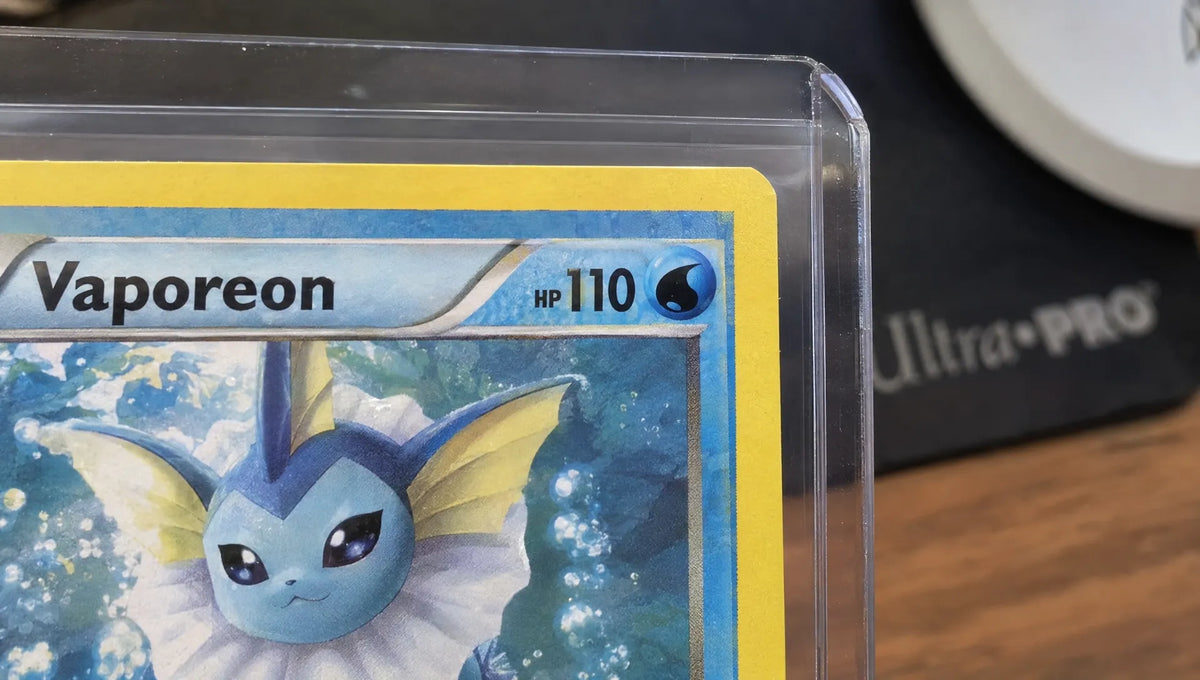
Uneven borders are the quickest clue to off-centre Pokémon cards, but they are not always enough to judge a card accurately. Camera angles, decorative artwork and differences between the front and back can all affect what you see. A card pulled straight from a booster pack can also be noticeably off-centre without having any wear.
The practical check is straightforward: compare opposite borders, measure each direction separately and inspect both sides. Here is how to do that without confusing an ordinary printing variation with a miscut or assuming a particular grading result.
What Does Off-Centre Mean on a Pokémon Card?
A card is off-centre when its printed design sits unevenly within the cut edges. For example, the left border might be noticeably wider than the right, or the top border might be thinner than the bottom.
Centring describes alignment, not wear. It is separate from scratches, whitening, dents and corner damage. A clean card can have poor centring, while a perfectly centred card can still be heavily played.
There are two directions to inspect:
- Left to right: Compare the widths of the left and right borders.
- Top to bottom: Compare the widths of the top and bottom borders.
Check these on the front and then repeat the process on the back. The two sides can have different centring, so a balanced-looking front does not guarantee a balanced back.
As a quick visual test, hold the card upright and look at the border widths rather than the position of the Pokémon itself. Artwork can be intentionally asymmetrical, so the character's position is not a reliable measurement reference.
How to Check Off-Centre Pokémon Cards at Home
You do not need specialist equipment for an initial assessment. Good lighting, a straight-on photograph and a basic image editor are usually enough to identify a noticeable imbalance.
Start With a Straight-On Photograph
Place the card on a clean, flat surface with a plain background. Position your phone directly above it, keeping the camera parallel to the card rather than photographing from an angle.
Include all four edges and avoid glare. If the card appears trapezoidal in the photograph, with one end wider than the other, retake the image. Perspective distortion can make a balanced card look uneven.
A sleeve or top loader is fine for a first look, but reflections and plastic edges can obscure the actual border. If you need to inspect the card outside its holder, handle it carefully by the edges with clean, dry hands. Do not remove it just to get a slightly better photograph if doing so risks damage.
Use the original, high-resolution photo where possible. Cropped marketplace screenshots and compressed images often lack the detail needed for close measurements.
Compare the Front and Back Independently
On a clearly bordered card, compare the distance between the physical edge and the same printed boundary on opposite sides. Use matching points, such as halfway down the left and right edges.
On the back, compare the printed border near the edges rather than judging whether the central Poké Ball looks centred. Familiar artwork can create a misleading visual impression.
For off-centre Pokémon cards, record four separate observations: front left/right, front top/bottom, back left/right and back top/bottom. Keeping these separate prevents a good result on one side from masking a problem on another.
How to Measure a Card's Centring Ratio
Centring is commonly expressed as a ratio, such as 50/50 or 60/40. This compares two opposite border widths, not the size of a border against the entire card.
For a left-to-right measurement, add the left and right border widths together. Then divide each border width by that total and multiply by 100.
For example, suppose the left border measures 2 mm and the right border measures 3 mm:
- Combined border width: 2 + 3 = 5 mm.
- Left share: 2 ÷ 5 × 100 = 40%.
- Right share: 3 ÷ 5 × 100 = 60%.
That gives 40/60 from left to right, often described as 60/40 centring with the larger number first. Record which side is wider if you want your notes to be unambiguous.
Pixel measurements work the same way. Borders measuring 24 and 36 pixels also produce a 40/60 split. This avoids placing a ruler or measuring tool against the card, although the photograph must be square-on and sharp enough to identify the boundaries.
Repeat the calculation for the top and bottom borders, then repeat both measurements on the back.
What Common Ratios Tell You
The following table explains the measurements, not the grade a card will receive.
| Centring ratio | What the measurement means |
|---|---|
| 50/50 | Both opposite borders have equal measured width |
| 55/45 | One border accounts for 55% of their combined width |
| 60/40 | The wider border is 1.5 times the narrower border |
| 65/35 | The wider border is about 1.86 times the narrower border |
| 70/30 | The wider border is about 2.33 times the narrower border |
Do not combine all four borders into one ratio. Left/right and top/bottom are separate measurements. A card could be close to 50/50 horizontally but noticeably off-centre vertically.
An at-home measurement is an estimate. If changing your measurement point by a pixel changes the result substantially, the image is not precise enough to support a confident claim.
What If the Borders Are Uneven or Hard to See?
Not every card has a simple frame that is easy to measure. Full-art cards, textured cards and designs with artwork extending towards the edges need more care.
Full-Art and Borderless Designs
Use a consistent printed boundary where one exists. Do not treat a shadow, background shape or decorative stripe as a border just because it is close to the edge.
If the front lacks a clear reference, inspect the back and compare the front with a reliable image of the same card, set and language. That comparison can help you distinguish intentional artwork placement from printing displacement. It does not replace an actual measurement.
For these off-centre Pokémon cards, it is better to describe the visible issue honestly than claim an exact ratio from an unclear boundary.
Borders That Get Wider Towards One Corner
Measure at several points along an edge if the border seems to taper. A single midpoint measurement can miss a design that is rotated relative to the cut edges.
Collectors often describe that slanted relationship as a diamond-cut appearance. It differs from a straightforward sideways or vertical shift, where opposite borders remain roughly parallel but have unequal widths.
First rule out camera distortion by taking another photograph. If the taper remains when the card is photographed correctly, note it separately from the basic centring ratio.

Off-Centre vs Miscut: What Is the Difference?
Ordinary off-centring leaves the card's design displaced within its edges. A more substantial cutting error may show unusual features, such as part of a neighbouring card or an alignment mark intended for the printing and cutting process.
Collectors commonly distinguish between a slightly uneven card and a recognisable miscut error, although terminology and grading classifications can vary.
An alignment dot can be a useful clue, but it is not a universal requirement for every cutting error. Equally, a tiny mark near a corner should not automatically be treated as an alignment dot without closer inspection.
A wide border alone does not establish a valuable error card. Error collectors look at how distinctive the mistake is, which card is affected and whether comparable examples attract buyer interest.
Off-centring is also not proof that a card is fake. Genuine cards can leave the factory with uneven borders. If authenticity is your concern, assess it separately using the checks in our guide to buying authentic Pokémon cards without getting burned.
How Centring Affects Grading
Centring is one part of professional grading alongside corners, edges and surface condition. A visually clean card with uneven borders may not meet a grading company's requirements for its highest grade.
However, there is no single centring ratio that guarantees a grade across all grading companies. Front and back requirements may differ, and a card still needs to satisfy the other condition criteria.
Before submitting off-centre Pokémon cards, check the grading service's current published standards. For example, PSA's official grading standards explain its grade definitions and centring requirements. Use the rules published when you submit rather than relying on an old forum post or a seller's claim.
A centring app or overlay can help estimate border proportions, but it cannot inspect every surface defect or promise a professional result. Treat statements such as “guaranteed 10” cautiously, even when the seller includes a measurement screenshot.
For New Zealand collectors, include submission fees, postage, insurance and any applicable taxes when deciding whether grading makes financial sense. A pleasing card for your binder does not necessarily need a slab.
Buying or Selling a Card With Uneven Borders
When buying online, request clear, straight-on photographs of both sides. A close crop of the artwork hides the very edges you need to judge.
Compare the card with examples of the same version rather than assuming every release should have identical border widths. If centring matters to your collection, decide what you find acceptable before buying, especially when paying a premium for a raw card advertised as a grading candidate.
When selling, use specific wording such as “right border visibly wider than left” rather than claiming a grading result. Provide an estimated ratio only if your photographs support it, and label that ratio as an estimate.
Value depends on more than alignment. Our Pokémon card price checklist explains how condition, rarity and demand fit into the wider assessment. Ordinary off-centring can reduce appeal to some buyers, while a distinctive cutting error may interest a different group of collectors.
Frequently Asked Questions
Can a pack-fresh Pokémon card be off-centre? Yes. Pack-fresh describes where the card came from, not its manufacturing quality. A newly opened card can have uneven borders and may also have other factory imperfections.
Does off-centring mean a card is damaged? Not in the same way as a crease or scratch. It is a manufacturing alignment issue, but it can still affect grading and buyer preferences. Assess wear and centring separately.
Is the front or back more important? Check both. Grading companies can apply different centring requirements to each side, so neither should be ignored. For personal collecting, you may care more about how the front displays.
Can I judge centring from a seller's photo? Often you can spot a clear imbalance, but precise ratios require a sharp, straight-on image with every edge visible. Ask for another photo if perspective, glare or cropping makes the borders unclear.
Check the Borders Before You Buy
The most useful habit is simple: inspect both sides, compare opposite borders and separate alignment from overall condition. If you measure a ratio, keep each direction independent and avoid turning an estimate into a promised grade.
When browsing Pokémon cards and other collectables at BigBoiSneakers, use these checks alongside the product details. If the photographs do not show enough to assess centring, request clearer images before deciding.